


-

Hide and Luig
-
Meccha Hunt
-
Fruit Ninja
-
Toaster Dash
-
Meccha Chameleon 3
-

Meccha Chameleon 2
-

Water Color Sort
-
Stickman Chameleon
-
Paint to Hide!
-
Paint&Seek Online
-
Meccha Obby
-

Paint or Seek: Chameleon Hide Online
-
Hide ‘N Seek!
-
Paint Strike
-
Meccha Chameleon Mobile
-

A Little to the Left
-
Among Us
-
Stickman Hook
Doodle Jump







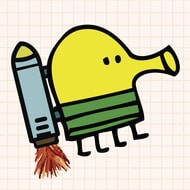
Doodle Jump looks like a notebook sketch and plays like a surprisingly deep reflex test. The Doodler — a four-legged blob drawn in pencil-line art — bounces automatically from platform to platform, and your only job is to tilt the screen left or right to adjust trajectory. That single-input constraint sounds trivial until you are deep into a run, the platforms are sparse and mixed with crumbling brown ones, and a UFO is lining up to abduct the Doodler from the right side of the screen while a bat swoops from the left.
Platform Types and What Each One Means
Doodle Jump uses four main platform types that communicate their behavior through color. Green platforms are solid and permanent — land on one, bounce again. Blue platforms move horizontally back and forth across the screen. Brown platforms crumble and fall the moment the Doodler lands, giving exactly one bounce before they disappear. White cloud platforms float and look stable but actually drift upward and off screen, which can strand the Doodler in a gap if the player does not recognize the type quickly enough.
The color coding system works well in early play and becomes a liability in long runs where platforms appear at speed and the player has less than a second to identify type and adjust landing position. Experienced Doodle Jump players develop a pattern-recognition reflex for brown platforms specifically — the slight difference in shade versus green becomes a fast peripheral read that triggers a trajectory adjustment before the Doodler is already falling toward the crumble.
Spring platforms, trampoline platforms, and rocket boots boost the Doodler to dramatically higher positions than a standard bounce. Spring platforms appear randomly and visually pulse with their coiled spring icon. Landing on a spring sends the Doodler two or three screens up in a single jump, which can vault over a section of sparse platforms that would have otherwise required careful navigation. Rocket boots attach to the Doodler and carry it upward for several seconds of automated flight. Both types effectively provide a “rest” from precision play before dropping back into the gap-navigation challenge.
Enemies and How Players Handle Them
The Doodler can shoot upward by tapping or clicking in most versions of Doodle Jump. Shooting destroys enemies in the Doodler’s direct upward path — monsters, UFOs, and black holes can be eliminated before they become threats. Monsters appear on platforms and shoot projectiles downward; running into a monster or its projectile ends the run. UFOs hover in fixed positions and abduct the Doodler if it rises to the UFO’s level while aligned horizontally. Black holes pull the Doodler in if it passes within their gravity range.
Monster projectiles are the most common death source for intermediate players. The Doodler’s upward trajectory is predictable to the monsters — they aim where the Doodler is headed rather than where it currently is, which means the standard bounce arc often leads directly into a projectile. Anticipating and shooting the monster before rising into projectile range is the correct response, but it requires recognizing the monster on the way up rather than only after the Doodler has already bounced past the safe point.
UFOs operate differently. They do not shoot — they are a positional threat that requires horizontal adjustment to avoid rather than shooting to eliminate. The Doodler must rise past the UFO level while positioned outside its gravitational pull radius. In tight platform configurations where horizontal movement is constrained by edges, a UFO can force the player into a difficult choice between a risky platform gap on one side and the UFO’s abduction zone on the other.
Black holes are the most disorienting enemy type. Their pull is gradual rather than immediate, which catches players off guard because the Doodler’s trajectory starts bending toward the black hole subtly before the danger becomes obvious. By the time the pull is visible, correcting away from it requires strong directional input that may overshoot to the opposite edge. Black holes in central screen positions are significantly more dangerous than those near the edges, where the player can push against the opposite wall to resist the pull.
The Endless Progression and Score Milestones
Doodle Jump tracks height in a continuous score that represents how high the Doodler has risen in a single run. There is no level completion screen — the run ends when the Doodler falls below the bottom of the visible screen area. The height score is compared against personal bests and, in versions with leaderboards, against other players. This makes every Doodle Jump run a pure distance challenge with no other objective.
Score milestones in the Doodle Jump community typically cluster around round numbers: 10,000 points, 50,000, 100,000. Players below 10,000 are considered beginners; consistent 50,000+ runs indicate genuine platform-reading competence. The 100,000 milestone marks the threshold where UFO management, black hole navigation, and enemy shooting are all handled reliably rather than by luck. Players who reach 200,000+ in a single run are rare enough that those scores generate discussion in casual gaming communities.
The score record debate in Doodle Jump has always involved questions about luck variance. A run that produces generous spring platforms early accelerates the Doodler to a height where the platform density has increased, creating a harder gauntlet at exactly the moment the run length has reduced tolerance for error. A run with fewer springs requires more careful platform-by-platform navigation but avoids the abrupt density jump. Players who chase high scores acknowledge that the early run platform distribution is a luck factor they cannot control.
Themed Worlds and How They Change Play
Different Doodle Jump themed editions introduce world-specific enemies and platforms without changing the core bounce mechanic. Jungle editions feature vines instead of springs and monkey enemies with different projectile patterns. Space editions remove standard ground below the Doodler, making falls immediately fatal with no recovery time. Halloween editions mix standard platforms with pumpkin platforms that behave like crumble variants.
The themed worlds are popular with players who have plateaued in the standard version because they provide new enemy patterns to learn without requiring new core mechanics. A player who has memorized standard monster projectile timing needs to relearn timing for jungle monkeys, which creates a brief re-engagement with the attention and pattern-recognition challenge that made the base game compelling before it became familiar.
Players who prefer the themed worlds to the standard version often cite enemy variety as the primary reason. The standard version’s monster set becomes predictable after extended play; themed enemies break the prediction in satisfying ways. This is a common dynamic in endless arcade games — the core mechanic retains appeal longer when the population of threats against it rotates.
Common Player Discussions and Criticism
The platform generation in Doodle Jump is not fully random — the algorithm ensures minimum platform density at any given height, which means truly unwinnable gaps are rare. However, the algorithm does produce difficult configurations where the only safe path requires threading a narrow moving platform while simultaneously positioning outside a UFO’s range. These configurations feel unfair to players who encounter them without expecting them, and the randomness of their appearance means players cannot prepare. The gap between “clearly unfair” and “just hard” is genuinely ambiguous in some cases, which is the community’s most consistent complaint about the generation algorithm.
The Doodler’s left-right wrapping — moving off the right edge of the screen causes it to reappear on the left — is a mechanic that novices often discover by accident and veterans use deliberately. Threading a trajectory that exits the right edge to reappear on the left and land on a specific platform is one of Doodle Jump’s more satisfying precise plays, and players who first discover wrap-around navigation describe it as one of the game’s most memorable moments.
Doodle Jump’s staying power comes from its honest simplicity. One input, one objective — reach as high as possible without falling. The platform types, enemies, and power-ups are layers built over a mechanic that never pretends to be more complex than it is. Players who have returned to Doodle Jump years after their first run consistently describe the experience as immediately familiar, which is the highest compliment an arcade game’s core mechanic can receive.
Comments
There are no reviews yet. Be the first one to write one.