


-
Hide and Luig
-

Meccha Hunt
-

Fruit Ninja
-

Toaster Dash
-
Meccha Chameleon 3
-

Meccha Chameleon 2
-

Water Color Sort
-
Stickman Chameleon
-
Paint to Hide!
-

Paint&Seek Online
-
Meccha Obby
-

Paint or Seek: Chameleon Hide Online
-
Hide ‘N Seek!
-

Paint Strike
-

Meccha Chameleon Mobile
-

A Little to the Left
-

Among Us
-

Stickman Hook
Two Neon Boxes









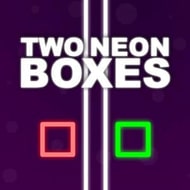
What does it mean to control two things at once that cannot share the same space? Two Neon Boxes frames that question as a puzzle platformer with a simple visual: two glowing squares, one blue and one orange, moving through a neon-lit obstacle course that demands they reach their respective goal tiles simultaneously. You move both boxes with the same inputs. If one slides left, so does the other. The entire game is built on the gap between “you control both” and “they are not the same.”
Simultaneous Movement and Why It Creates Problems
In Two Neon Boxes, directional inputs apply to both boxes at the same time. Press right and both boxes move right. Press up and both move up. The boxes cannot be moved independently — every action you take affects both simultaneously. This shared control is the game’s central mechanic and the source of every puzzle it generates.
The first puzzle type this creates is alignment. If the blue box needs to move right but the orange box is already at the right wall, pressing right moves only the blue box because the orange has nowhere to go. Using walls as stoppers for one box while moving the other is the foundational technique in Two Neon Boxes. Players who understand early that walls are as important as empty space begin making progress much faster than those who try to move both boxes freely and wonder why alignment is impossible.
The second puzzle type is sequencing. Many Two Neon Boxes configurations require reaching a state where one box is positioned precisely so that a future move sequence delivers both boxes to their goals in the right order. A single misstep — moving right one tile too early, for instance — can position the orange box such that no future input delivers it to the goal without simultaneously pushing the blue box off the intended path. Sequence puzzles in Two Neon Boxes often look unsolvable until a single non-obvious first move reveals the entire solution chain.
Neon Obstacles and Their Rules
Two Neon Boxes introduces colored obstacle tiles as the game progresses. A red barrier tile blocks one color of box but not the other. A blue barrier lets the orange box through but stops the blue box. Orange barriers work in reverse. These color-selective walls create scenarios where the two boxes can be separated without hitting an impassable wall — one box continues through the barrier while the other stops.
Color barriers fundamentally change the puzzle type from pure alignment to selective separation. Instead of using walls to position one box while moving the other, players use color barriers to advance one box while holding the other in place. Combining color barrier passage with wall-stop positioning in the same puzzle creates the game’s most complex configurations, where both boxes need to thread through barriers and wall-stops in a specific interleaved sequence to reach their goals.
Switch tiles appear in later Two Neon Boxes stages. Stepping on a switch opens or closes a gate elsewhere in the level. The switch may activate when either box touches it, or only when a specific colored box triggers it — the visual design of the switch indicates which. Gate-and-switch puzzles require planning the box routes around which switch each box will trigger and in what order, adding a temporal element to the spatial planning the game normally demands.
The Visual Language of the Neon Style
Two Neon Boxes uses a dark background with glowing colored elements throughout. The blue and orange boxes emit soft ambient light; barrier tiles glow with their respective filtering colors; goal tiles pulse gently when a box is aligned with them. This visual grammar is functional — the glow intensity and color coding communicate information about which elements interact with which boxes without any text explanation needed.
Players consistently mention the neon aesthetic as a reason they found Two Neon Boxes approachable despite the puzzle complexity. The visual contrast is high enough that box positions and barrier locations are always legible, even in the most crowded puzzle configurations. Poor color contrast in puzzle games with small interactive elements is a common source of frustration; Two Neon Boxes avoids this by using maximally distinct colors — blue and orange sit opposite each other on the color wheel — and high luminosity against the dark field.
The sound design follows the same logic. Each box makes a slightly different tone when it moves, and the tones harmonize when both boxes move simultaneously. Players describe hearing the sound difference as a useful confirmation that only one box moved when they expected both to — an audio cue that supplements the visual tracking and helps catch positioning errors before they cascade into unsolvable states.
Where Two Neon Boxes Gets Genuinely Hard
The difficulty curve in Two Neon Boxes becomes steep in stages that combine three or more mechanics simultaneously: color barriers, switch tiles, and wall-stop positioning all present in one puzzle. At this complexity level, the player must hold a mental model of both boxes’ positions, the current gate state, and the sequence of inputs required to deliver both to their goals — across a puzzle that may require fifteen or more moves to solve correctly.
What makes these complex stages hard is not the individual mechanics — each one is simple in isolation. The challenge is holding the full state in mind simultaneously. Players who excel at visualization puzzles find this stage range the most engaging; players who rely on trial-and-error find it the point where Two Neon Boxes stops being fun and starts feeling like work. The game does not hold your hand through this transition, which is either a design strength or a flaw depending on the player’s tolerance for unguided puzzle complexity.
The community’s most-discussed quality-of-life complaint about Two Neon Boxes is the undo function, specifically its absence or limited availability. When a long sequence leads to a dead end, the only recovery in many versions is restarting the level. Players who have invested fifteen careful moves into a Two Neon Boxes puzzle only to discover the path is blocked describe the reset as punishing compared to a per-move undo. This single design choice generates more discussion than any other element of the game.
Two Neon Boxes earns its difficulty because the simultaneous-control mechanic is genuinely novel for players who have not encountered it before. The constraint — two objects, one controller — generates puzzles that feel impossible until they click, at which point the solution feels obvious and elegant in retrospect. That click moment is what the game is designed to deliver, and when it arrives, it arrives with the specific satisfaction of a logic puzzle solved rather than a reflex challenge beaten.
Comments
There are no reviews yet. Be the first one to write one.