


-
Hide and Luig
-

Meccha Hunt
-
Fruit Ninja
-
Toaster Dash
-
Meccha Chameleon 3
-

Meccha Chameleon 2
-

Water Color Sort
-
Stickman Chameleon
-
Paint to Hide!
-
Paint&Seek Online
-
Meccha Obby
-

Paint or Seek: Chameleon Hide Online
-
Hide ‘N Seek!
-
Paint Strike
-

Meccha Chameleon Mobile
-
A Little to the Left
-

Among Us
-

Stickman Hook
Smash Karts







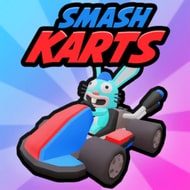
Smash Karts looks like a cheerful cartoon go-kart race with round-headed drivers and candy-colored tracks, but it plays like a demolition derby where the finish line never mattered. There are no laps to complete and no checkered flag anywhere on the map. Instead you circle tight arenas hunting weapon crates, chasing rivals with rockets and mines, and trying to be the last kart smoking instead of the one that just got launched off a ledge.
| Genre | Multiplayer kart battle arena |
| Objective | Eliminate rival karts and rack up the most kills or points |
| Weapons | Eleven distinct pickups, from rockets to the Invincibility Star |
| Controls | Steering, drifting, and a dedicated weapon-fire button |
Weapons That Decide Every Fight in Smash Karts
The core mechanic in plain terms: you drive around a small arena picking up floating weapon crates, and whatever pops out decides how the next few seconds of combat go. Some weapons reward patience, some reward aggression, and knowing which one you are holding before a rival rounds the corner is half the skill in Smash Karts. Beginners get this wrong constantly, firing the first weapon they see instead of positioning for a clean shot.
- Rockets travel in a straight line and reward good aim over open ground
- Mines sit invisible until triggered, perfect for blocking a chokepoint or a corridor
- The Machine Gun fires a rapid stream of bullets for close-range chip damage
- Cannonballs arc over obstacles, useful when a rival is hiding behind cover
- The Invincibility Star grants brief total immunity, and any contact with a rival during that window is an instant elimination
That last pickup is the one players argue about most. Landing it seconds before a match ends feels like a wasted gift, while grabbing one mid-fight against a cluster of rivals can flip a losing match in seconds. New players tend to panic and waste it chasing one target instead of driving straight through the middle of a crowd.
Crate priority matters more than beginners realize. Grabbing a weapon the moment it spawns near a group of rivals is usually worse than circling wide and letting the fight thin out first, since arriving late loaded beats arriving early empty.
Sizing Up the Arena Layout in Smash Karts
Every map rewards a different approach, and recognizing that within the first few seconds of a round separates players near the top of the scoreboard from those who just get farmed by rockets. A wide-open arena with ramps and a raised central platform turns that platform into a kill zone where a kart gets shot at from every direction at once, so experienced players avoid parking there except to grab a crate and roll straight back off the edge.
Tighter arenas flip that logic completely. Cramped corridors reward mines and close-range weapons far more than rockets, since there is rarely enough open space for a straight-line shot to land clean. Once you can recognize a map by its silhouette alone, you start adjusting weapon priorities before you have even picked one up.
Casual players tend to treat every arena the same way, driving the same loop regardless of layout. Players chasing a higher score adapt their route within the first few seconds of loading in instead.
The Graveyard, the Lava Pit, and Other Named Arenas
Smash Karts rotates through a roster of named battlegrounds, each with its own reputation among regular players. The Graveyard is a dim map built around tight paths threading between tombstones, and it is where mines earn a reputation as one of the most punishing weapons in the game, since a rival rounding a blind corner rarely sees one coming. Lava Pit surrounds the arena with an environmental hazard rather than just other karts, turning every knockback into a potential elimination near the edge.
Space Station and Sky Arena lean into vertical platforming, with ramps and gaps that punish careless driving even without a weapon involved, while Snowpark and Slick ‘n Slide add slippery surfaces that mess with drift timing. Smash Fort, Steky’s Speedway, and the Gravel Pit each add their own quirks, and players who stick around develop clear favorites and maps they groan about.
A steampunk-themed arena built around moving gears and shifting elevation adds a layer few other maps have. A route that was safe a moment ago can dump you into a gap if you stop tracking the machinery.
Hazards Built Into the Terrain
Beyond the weapons players fire at each other, several maps carry hazards baked into the terrain. Water-themed arenas feature the Lobster Buoy, a stationary hazard that behaves much like a mine and catches drivers focused on chasing a rival instead of watching the ground ahead. Combined with ledges, lava, and narrow platforms, elimination in Smash Karts is rarely just about who has the better weapon; often it comes down to who remembered the track itself.
Knockback near a ledge is one detail new players consistently underestimate. A hit that is harmless mid-arena becomes a full elimination near an edge, which is why experienced drivers reposition constantly instead of holding one favorite spot.
Terrain hazards also change how aggressively players use weapons. A rocket fired near lava only needs to nudge a rival to finish the job a direct hit elsewhere would not.
Free For All, Capture the Flag, and Other Modes
Free For All is the mode most players learn Smash Karts on, a straightforward scramble where every kart is a target and the scoreboard tracks individual eliminations. Capture the Flag changes the rhythm entirely, since positioning and escort routes suddenly matter more than kill count, and a kart loaded with mines becomes far more valuable for zone control than for chasing kills.
Hat Holder and Gem Collector shift the objective again, rewarding players who can hold onto something rather than just outshoot everyone else, pulling in a different crowd than the Free For All regulars. Seasonal event modes rotate in with themed cosmetics attached, drawing back players who had drifted away.
Switching between modes forces a mental reset that trips up experienced players. A driver used to aggressive habits often gets punished the moment a Capture the Flag match rewards patience over kill count instead.
The Garage: Karts, Hats, and Cosmetic Progression
Playing matches earns experience that unlocks new characters, karts, and hats inside the Garage, the menu where all of it gets equipped before a round starts. With more than a hundred hat options ranging from wizard hats and top hats to plungers and saucepans, cosmetic variety is one of the main long-term hooks for players who have already learned every map by heart.
None of this touches performance. Kart skins, paint jobs, and hats in Smash Karts are purely visual, so a fully decked-out kart handles identically to a default one, and players who ask whether a particular kart is objectively better are working from a myth rather than anything the game tracks.
Leveling up unlocks new Garage entries gradually rather than all at once. That steady drip is part of why cosmetic collecting becomes its own long-term goal once the maps and weapons stop feeling new.
Respawns, Streaks, and What Actually Wins a Match
Getting destroyed in Smash Karts is rarely a big setback since respawns happen fast and matches are built around constant back-and-forth rather than any single elimination deciding the outcome. That pace is exactly what divides player opinion: some find the rapid respawn cycle keeps the action from ever going stale, while others argue it flattens the tension since a bad death barely costs anything.
Advanced players squeeze extra value out of the seconds right after respawning. A fresh kart often reappears away from the chaos with enough time to grab a weapon crate before anyone notices it is back.
By the time a match reaches its final minute, players holding a kill streak become priority targets for everyone else on the map, and watching a dominant kart get ganged up on by three rivals at once is a moment regulars recognize instantly from the sound of overlapping explosions alone. Smash Karts rewards the driver who keeps moving, keeps reading the crate spawns, and never sits still long enough to become an easy shot for the next rocket in Lava Pit or the next mine in the Graveyard.
Comments
There are no reviews yet. Be the first one to write one.