



-

Hide and Luig
-

Meccha Hunt
-

Fruit Ninja
-
Toaster Dash
-
Meccha Chameleon 3
-

Meccha Chameleon 2
-

Water Color Sort
-
Stickman Chameleon
-
Paint to Hide!
-
Paint&Seek Online
-

Meccha Obby
-

Paint or Seek: Chameleon Hide Online
-

Hide ‘N Seek!
-

Paint Strike
-
Meccha Chameleon Mobile
-

A Little to the Left
-

Among Us
-

Stickman Hook
Melatonin Rhythm







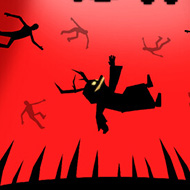



What happens when the beat splits into two lanes at once and you’re still thinking in one? That’s the wall most newcomers hit a few songs into Melatonin Rhythm, a game that looks like a simple side-scrolling note-catcher for its first thirty seconds and then asks you to track jumps and attacks on completely separate keys without slowing down for you.
| Genre | Music / Rhythm |
| Platform | Browser (HTML5) |
| Controls | D / F (top row), J / K (bottom row) |
| Style | 8-bit side-scrolling rhythm |
The setup is deceptively plain: a small character runs forward automatically while musical notes stream in from two rows. The top row uses D and F for jump and air-attack beats, the bottom row uses J and K for ground-attack beats, and the entire idea of Melatonin Rhythm is keeping both rows in sync as the screen fills up with more of them.
How the Two-Row System Works in Melatonin Rhythm
Early stages train your hands on one row before the other kicks in, which is generous compared to what’s coming. Once both rows are active, you’re effectively reading two rhythm tracks that occasionally line up and occasionally deliberately don’t — a top-row beat landing a half-count off from a bottom-row one is where most runs fall apart the first time through a song.
Old-school dance-mat games trained a specific kind of muscle memory: whole-body timing to a single beat. Melatonin Rhythm asks for something closer to two-handed independence, more like drumming than dancing, and that shift is exactly what makes returning players describe the later songs as “a different game” from the opening ones.
The Song List Carries Melatonin Rhythm
- An original 8-bit remix built around the game’s namesake track
- A moodier, slower-tempo track that tests sustained accuracy over flashy combos
- A high-energy track pulled from a well-known crossover collaboration, remixed into chiptune form
- A cover track blending two vocalists’ parts into one combined beatmap
Each song reuses the same core rules but changes the pacing enough that a strategy that clears one cleanly can fall apart on the next. The slower track punishes players who rely on momentum to carry them through missed inputs, since there’s nothing to hide behind when a beat is spaced out and exposed.
Reading the Screen Before It Gets Loud
Once the screen genuinely fills up — which happens fast, usually inside the first chorus — the honest advice from players who’ve cleared every track is to stop watching your own character and start watching the incoming lane instead. Reacting to the character model is always a beat late by the time the pattern gets dense.
Is Melatonin Rhythm hard to learn?
The first song is genuinely easy and mostly exists to teach the controls. Difficulty ramps sharply once both rows activate together, so don’t judge the game’s ceiling from how the opening minutes feel.
Do combos or misses affect the score in Melatonin Rhythm?
Yes — clean, consecutive hits build toward a higher score than the same number of hits broken up by misses, which is why players who slow down deliberately after a missed beat tend to score lower than ones who keep pace and accept the occasional gap.
Which song is the best starting point?
The opening 8-bit remix track, since it introduces the two-row system at a pace slow enough to build the D-F-J-K habit before the faster covers demand it instantly.
Melatonin Rhythm rewards the same thing every good rhythm game does — not perfect memorization, but trusting your hands to move before your eyes finish confirming the pattern, which is a strange kind of confidence to build in an 8-bit game this small.
Comments
There are no reviews yet. Be the first one to write one.