


-

Hide and Luig
-

Meccha Hunt
-

Fruit Ninja
-

Toaster Dash
-
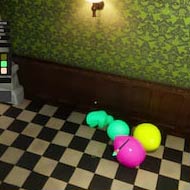
Meccha Chameleon 3
-

Meccha Chameleon 2
-

Water Color Sort
-

Stickman Chameleon
-

Paint to Hide!
-

Paint&Seek Online
-

Meccha Obby
-

Paint or Seek: Chameleon Hide Online
-

Hide ‘N Seek!
-

Paint Strike
-

Meccha Chameleon Mobile
-

A Little to the Left
-

Among Us
-

Stickman Hook
Chroma Wave
What exactly is a Chroma Wave, and why does it appear in Meccha Chameleon’s later zones without explanation? The Chroma Wave is a color pattern that appears in sequences of four or more same-color gates delivered in alternating tempo — fast, slow, fast, slow — creating a rhythmic color pulse rather than a steady gate stream. The tempo alternation changes the input timing model for each gate without changing the color requirement, which means players who have calibrated their switch timing to the standard even gate tempo fail Chroma Wave sequences by switching at the wrong moment in the pattern’s rhythm.
The Chroma Wave Pattern and Its Timing
A Chroma Wave sequence in Meccha Chameleon presents four gates of the same color in alternating tempo: the first gate arrives at standard spacing, the second at reduced spacing (approximately 30% shorter), the third at standard, the fourth at reduced. This alternation creates a two-beat rhythmic pattern within the same-color sequence — standard beat, short beat, standard beat, short beat. Players who experience a Chroma Wave for the first time typically handle the first two gates correctly and miss the second or fourth gate because they respond to it at standard timing, arriving slightly after the contact window for the reduced-spacing gates.
The reduced-spacing gates do not require faster color switching — the color is the same throughout the Chroma Wave, so no switching is needed. What the reduced spacing requires is slightly earlier arrival positioning. Players who maintain constant forward momentum meet the reduced-spacing gate at standard timing; players who have slightly decelerated to “read” the current gate arrive late. The Chroma Wave penalizes any pace variation during the same-color sequence, which is why players who slow to confirm color before contact — an occasionally useful habit in other contexts — find Chroma Wave sequences unexpectedly punishing.
Chroma Waves containing six gates extend the alternating pattern to three full cycles. Eight-gate Chroma Waves appear in Chroma Void and Prism Peak and require maintaining consistent momentum across four full cycles of the standard-reduced pattern. Players who are solid through two or three cycles but decelerate at the fourth cycle typically fail the eighth gate — the longest Chroma Wave gate is always the last, which is where any accumulated pace deviation becomes large enough to miss the reduced-spacing contact window.
Where Chroma Waves Appear in Zone Progression
Chroma Waves appear first in Sunburst Plains as an occasional pattern variant among standard gate sequences. Sunburst Plains Chroma Waves use four-gate sequences exclusively. By Chroma Void, Chroma Waves of six and eight gates are standard content. In Prism Peak, Chroma Waves appear in combination with Mirror Lizard gates — a Chroma Wave sequence where the final two gates require Mirror color rather than the Wave color, adding a complement switch to the pattern’s conclusion. The Mirror Wave combination in Prism Peak is one of the zone’s most demanding sequences because it asks the player to maintain consistent Wave momentum through the first six gates and then apply Mirror mapping at the exact moment the Wave’s rhythm has created the most momentum-dependent positioning.
Players who have played standard Sunburst Plains Chroma Waves and then encounter a Prism Peak Mirror Wave for the first time typically fail the Mirror-required gates. The Wave’s rhythmic momentum creates a strong expectation that the sequence will continue in the same color, and the Mirror switch requirement violates that expectation at the pattern’s most momentum-committed moment. Learning to read the Mirror Wave combination — looking for Mirror Lizard presence indicators before the Wave’s final gates — is a specific preparation step that Prism Peak requires before it can be navigated cleanly.
ChromaChain and Chroma Waves
Chroma Waves are generally ChromaChain-positive sequences because they use the same color throughout, eliminating any risk of color-reading error during the pattern. A player who has the Wave’s momentum pattern correct clears four to eight consecutive gates without any color-switch risk — only pace consistency is required. For ChromaChain purposes, a Chroma Wave section is an opportunity to accumulate chain links at low miss-risk, which is why experienced players prioritize getting the Wave’s first gate contact right and then flowing through the pattern at consistent pace.
The chain break risk in Chroma Waves is almost always the reduced-spacing gates — specifically the second and fourth gates in a standard four-gate Wave. Players who have a Chroma Wave miss in a high-chain run almost always missed one of these reduced-spacing gates rather than a color error. Because the chain break risk is tied to momentum consistency rather than color reading, Chroma Waves can be broken even when the player is executing color switching correctly, which is a disorienting miss type that can lead players to incorrectly diagnose the cause as color error and attempt a switch they did not need to make.
Distinguishing Chroma Waves from Standard Same-Color Sequences
Standard same-color sequences — multiple consecutive gates requiring the same color — appear in Meccha Chameleon at even spacing throughout. A Chroma Wave differs by having the characteristic tempo alternation rather than even spacing. Players who fail to distinguish between a standard same-color sequence and a Chroma Wave apply the wrong pacing model: standard even pacing for a Chroma Wave produces the same effect as arriving late for the reduced-spacing gates.
The visual indicator of a Chroma Wave is a wave-pulse animation on the gate frames when the sequence begins. The first gate of a Chroma Wave pulses with a brief ring effect that standard same-color gates do not display. Players who learn to recognize this first-gate pulse — which is visible at two-gate-ahead reading distance — have enough advance notice to transition from standard even-pacing into Chroma Wave two-beat rhythm before contacting the first gate. Players who miss the pulse indicator or do not know to look for it encounter the second gate’s reduced spacing as a surprise.
- Do Chroma Waves always use the same color throughout? In standard versions, yes. A Chroma Wave sequence is definitionally a same-color pattern — the wave is the tempo pattern, and the color is the constant. The Mirror Wave combination in Prism Peak is a hybrid where the Wave tempo applies to the first portion and the final gates require complement colors, but this is a Prism Peak-specific variant rather than a standard Chroma Wave modification. In all zones through Chroma Void, if a Chroma Wave begins in Chroma Blue, all gates in the Wave require Chroma Blue.
- Can Color Lock help with Chroma Wave sequences? Yes, and it is one of the most straightforward uses of the Color Lock mechanic. Entering a Chroma Wave with Color Lock active on the Wave’s required color eliminates any accidental switch risk during the pattern — no tap input will change the color during the Wave’s run. The risk is the Color Lock release timing at the Wave’s end: if the post-Wave gate requires a different color, the lock must be released and a switch initiated before contact. Players who have good Color Lock release timing find it very useful in Chroma Wave sections; players who have slow release timing sometimes fail the first post-Wave gate because the release-and-switch sequence does not complete in time.
- Why do I miss the same Chroma Wave gate every attempt? A consistent miss on the same gate within a Chroma Wave is almost always a pace calibration error rather than a color error. If the miss is consistently on gate two or gate four, the reduced-spacing gates are arriving before the player’s position. The fix is maintaining slightly higher constant forward pace through the entire Wave sequence rather than the deceleration that typical gate approach habits build in. Run a deliberate no-deceleration approach to the Wave for three or four attempts specifically to identify whether the gate miss disappears at higher constant pace — if it does, pace was the problem.
Chroma Waves in Meccha Chameleon are one of the game’s more elegant difficulty additions because they use the same visual and color information as standard gates but change the mechanical timing requirement without announcement. Players who have internalized even gate spacing as a movement model discover through Chroma Waves that their internalized timing is a habit rather than a rule — and that the game has more than one timing language. The alternating tempo of the Wave, once learned, becomes as automatic as the even-spacing model it supplements, and players who have internalized both find themselves switching between timing modes as naturally as they switch between colors.