


-
Hide and Luig
-
Meccha Hunt
-
Fruit Ninja
-
Toaster Dash
-
Meccha Chameleon 3
-
Meccha Chameleon 2
-

Water Color Sort
-
Stickman Chameleon
-
Paint to Hide!
-
Paint&Seek Online
-
Meccha Obby
-
Paint or Seek: Chameleon Hide Online
-
Hide ‘N Seek!
-
Paint Strike
-
Meccha Chameleon Mobile
-
A Little to the Left
-
Among Us
-
Stickman Hook
Blumgi Slime






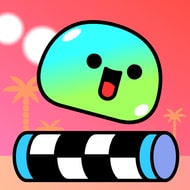
One button is the entire control scheme in Blumgi Slime, and yet that single hold-and-release input somehow carries a slime character through 150 levels spread across 30 distinct worlds without ever feeling like it’s run out of ideas.
| Genre | Platformer |
| Levels | 150 across 30 worlds |
| Controls | Hold to charge jump, release to leap |
| Modes | Single-player and two-player |
The core jump works entirely on hold duration. Press and hold the action button and your slime compresses, building up height and force the longer you keep holding, then releases into a leap the moment you let go. A short tap produces a small hop; a longer hold sends the slime arcing much further, which means every jump is really a small decision about exactly how much commitment a gap deserves.
Reading Gaps Correctly in Blumgi Slime
Misjudging a hold is the single most common way to fail a level — overcharge a jump meant for a short gap and you overshoot into a hazard on the far side; undercharge one meant to clear a wide gap and you simply fall short. Neither mistake is about reflexes so much as reading the gap correctly before committing to how long you hold the button.
The Slime Types That Change How You Play
- A bouncy slime, suited to levels built around chaining jumps off multiple surfaces in sequence
- A sticky slime, able to cling briefly to walls and surfaces a standard jump would slide right off of
- A floaty slime, with slower descent that gives more time to adjust mid-air on tricky landings
- A stretchy slime, useful for reaching gaps and ledges a normal jump falls just short of
Each slime type isn’t just a cosmetic swap — levels are frequently built around the specific power a given slime brings, which means the same obstacle that’s trivial with the sticky slime’s wall-cling can be genuinely difficult attempted with a type that doesn’t share that ability.
150 Levels Means the Hazards Keep Layering
Moving platforms, bouncy pads, slippery floors, and tricky, narrow gaps don’t appear one at a time and then get replaced by the next hazard type — they stack. A level deep into one of the 30 worlds might combine a slippery floor with a moving platform timed against a narrow gap, which means the hold-and-release jump you mastered in world one has to be applied with far more precision by the time the later worlds arrive.
Slippery floors change how far a charged jump actually carries you. Momentum on a slippery surface doesn’t behave the same as on solid ground, and players who’ve pushed deep into Blumgi Slime’s world list describe deliberately undercharging jumps on slippery sections, since the surface itself adds extra distance a normal charge wouldn’t need to account for.
Playing Solo Versus Two-Player
The two-player mode doesn’t change the core jump mechanic, but it does change the pressure — racing another slime through the same obstacles turns a level you’ve already mastered solo into something that suddenly punishes hesitation differently, since a charged jump held a fraction too long is now a visible mistake your opponent can capitalize on.
- Do all 30 worlds in Blumgi Slime use the same slime type? No — different worlds are frequently built around specific slime types, so the power you’re using changes which strategies actually work for a given stretch of levels.
- Is the two-player mode split-screen or a direct head-to-head race? It’s designed as a direct head-to-head format, letting two players race through the same level layout and compare who clears it first.
Why a One-Button Game Doesn’t Feel Shallow
It would be easy to assume a game built on a single input runs out of ideas quickly, but Blumgi Slime avoids that by changing the context around the jump instead of the jump itself. The button never gains a second function, never turns into a combo system — the challenge scales entirely through what’s placed around that one action, which keeps the controls approachable for a first-time player while still leaving genuine room for the later worlds to demand real precision.
That restraint is deliberate, and it’s part of why the game reads as approachable to newcomers despite having a genuinely long level list behind it. Nothing about world 30 requires learning a new control scheme — it requires applying the exact same hold-and-release timing you learned in world one, just with far less room for error.
The Flag as the Only Goal That Matters
Every level in Blumgi Slime strips its objective down to reaching a single flag, with no secondary collectibles competing for attention along the way. That singular focus keeps each level from feeling cluttered with side objectives, letting the platforming itself — the charge, the release, the read on the next gap — stay the only thing a player has to think about from the first jump to the last.
By world 30, the single-button jump that felt almost too simple in the opening levels has been stretched into a genuine skill — reading a gap, choosing a slime type, and charging exactly the right amount, all without a single extra control ever being added to Blumgi Slime’s original idea.
Comments
There are no reviews yet. Be the first one to write one.