


-
Hide and Luig
-

Meccha Hunt
-
Fruit Ninja
-

Toaster Dash
-
Meccha Chameleon 3
-

Meccha Chameleon 2
-

Water Color Sort
-
Stickman Chameleon
-
Paint to Hide!
-
Paint&Seek Online
-

Meccha Obby
-

Paint or Seek: Chameleon Hide Online
-
Hide ‘N Seek!
-
Paint Strike
-

Meccha Chameleon Mobile
-

A Little to the Left
-

Among Us
-

Stickman Hook
Bubble Shooter







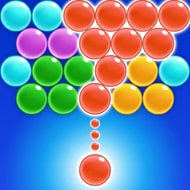
In Bubble Shooter you start with a cluster of colored bubbles packed tight against the ceiling and a cannon at the bottom that holds the next two bubbles you will fire. The first few shots feel like housekeeping. The cluster thins. Then you fire a purple into a gap that does not connect to any purple above it, the orphaned bubble sticks to the ceiling, and the cluster has grown by one. Bubble Shooter’s entire learning curve lives in that moment — understanding not just where a bubble lands, but what gets left behind when it misses.
Matching, Dropping, and the Physics of the Cannon
Bubble Shooter works on one rule: fire colored bubbles from the cannon at the bottom, and any group of three or more same-colored bubbles that connects on impact disappears. What falls after a clear is the second rule: any bubbles that were only connected to the cluster through the cleared group — hanging below it with no other attachment to the ceiling — also drop. Drops are worth bonus points and, more importantly, clear large sections of the cluster at once.
The cannon fires in a straight line toward where you aim, and bubbles bounce off the left and right walls. This bank shot mechanic is Bubble Shooter’s primary skill expression. A direct shot requires no calculation beyond matching the color. A bank shot requires reading where the bounced bubble will land on the far side of the screen, accounting for the fact that the angle of incidence equals the angle of reflection and the cluster may have gaps that change the final landing position.
The incoming queue shows the next bubble in line after the one currently loaded. Managing this queue — deciding whether to shoot the current bubble now or swap it with the queued one — is a skill that becomes more useful as the cluster density increases and the “safe” shot targets become harder to find. Many Bubble Shooter players develop a habit of checking the queue before every shot and swapping when the queued color opens a better chain than the current one.
Ceiling Attachment and How Games End
Bubbles in Bubble Shooter are attached to the ceiling or to other bubbles that trace a path back to the ceiling. This attachment chain is what makes the drop mechanic work. If you clear a section that was the only connection between a lower cluster and the ceiling, everything in that lower section falls. In early levels, the ceiling is the top row; as the game progresses, the cluster descends a row at fixed intervals, and the ceiling attachment moves down with it.
Games end when the cluster crosses the red line near the bottom of the screen. Every bubble that misses a match or adds a new bubble to the cluster brings this line closer. This creates a pressure loop specific to Bubble Shooter: the penalty for missing a match is not just a wasted shot but a structural change to the cluster that makes the next shot harder. A misfire in the wrong place creates an isolated bubble that must be connected later, which forces future shots to solve both the cluster and the orphan.
The game’s pace accelerates naturally as the cluster thickens. More colors are present, fewer clear pathways exist, and bank shots become the primary tool for reaching specific color pockets. Players who never develop bank shot accuracy find that Bubble Shooter stalls for them in the mid-game difficulty range — all the easy direct shots have been fired, and what remains requires angles.
Advanced Technique: Setting Up Drops
The highest-value shots in Bubble Shooter are not the ones that complete a three-bubble match — they are the shots that sever a large section of the cluster from the ceiling attachment. A drop shot requires identifying a small match that happens to be the only connection between a large hanging section and the rest of the cluster. Clearing that small match drops the entire section at once, generating a cascade of bonus points.
Finding drop setups involves reading the cluster from top to bottom and identifying thin connection points — spots where the cluster narrows to a single line of bubbles. These narrow points are natural drop setup targets. The challenge is that the color required to trigger the drop may not be the current bubble, or the bank shot required to reach a high cluster position may be blocked by intervening bubbles. Experienced Bubble Shooter players develop the habit of identifying potential drop targets at the start of each level and working toward them over multiple shots rather than clearing opportunistically.
The community term “snipe” refers to a bank shot that lands precisely in a narrow gap to reach a specific bubble behind the main cluster body. Snipes are high-risk because a slightly off angle produces an orphan rather than a match, but successful snipes are the defining play of competitive Bubble Shooter runs. Players who have internalized the bank shot geometry can call snipes consistently, which separates experienced play from casual clearing significantly enough that the two styles look like different games.
What Bubble Shooter Veterans Find Frustrating
Color RNG is the primary source of frustration in Bubble Shooter. The cannon distributes colors based on what is present in the cluster, which means rare colors in the cluster generate rare appearances in the queue — but never at zero frequency. Players can face extended sequences where a needed color simply does not appear in the queue while the cluster’s one remaining patch of that color is buried behind three other shades. The game does not allow you to choose your bubbles; you manage what arrives, and sometimes what arrives is unhelpful five shots in a row.
The orphan bubble problem also generates complaints. A shot that creates a single isolated bubble touching nothing in the main cluster adds one bubble to the ceiling and forces a future shot to reach and clear it. In a cluttered cluster, orphans accumulate in hard-to-reach corners and become the final shots of a dying game — unavoidable misses that add bubbles faster than shots can clear them. Most Bubble Shooter deaths come from orphan accumulation rather than direct color mismatches, which means misfire management is more important than matching speed in the long run.
Does Bubble Shooter ever end?
Yes, but only by clearing the entire cluster or by the cluster crossing the failure line. There is no time limit in standard Bubble Shooter — the game can technically be played indefinitely in a single attempt if every shot either clears a match or can be leveraged into a future chain without crossing the bottom threshold. In practice, the finite number of colors present in any cluster means there is always an endpoint, either successfully clearing everything or running out of viable shots before the cluster crosses the line.
What makes a good Bubble Shooter shot?
A good shot does one of three things: completes a three-bubble match that clears the group, triggers a drop by severing a hanging section, or positions a bubble where it enables a future drop or match even without an immediate payoff. Shots that simply add to the cluster — orphans — are the only category of bad shots. Even matching a group of three is only an adequate shot unless it also drops hanging sections, which is why experienced players evaluate every shot by what it enables next rather than what it clears immediately.
Bubble Shooter is one of those games that contains a genuinely deep skill layer underneath an interface that communicates almost nothing about that depth. The bank shots, the drop setups, the queue management, the orphan tracking — none of this is taught, and most casual players never encounter it because the early game is forgiving enough to survive without it. Players who push into the harder cluster configurations and discover that Bubble Shooter rewards systematic play rather than hopeful color matching tend to stay with it far longer than they originally expected.
Comments
There are no reviews yet. Be the first one to write one.