


-

Hide and Luig
-

Meccha Hunt
-

Fruit Ninja
-

Toaster Dash
-
Meccha Chameleon 3
-

Meccha Chameleon 2
-

Water Color Sort
-

Stickman Chameleon
-
Paint to Hide!
-
Paint&Seek Online
-

Meccha Obby
-

Paint or Seek: Chameleon Hide Online
-

Hide ‘N Seek!
-

Paint Strike
-

Meccha Chameleon Mobile
-

A Little to the Left
-

Among Us
-
Stickman Hook
Geometry Dash Wave








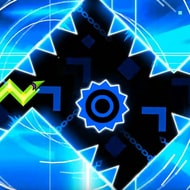
You clip the first spike wall by half a pixel and don’t die — and that’s when Geometry Dash Wave stops being a test of speed and becomes a test of nerve. The Wave is one of the most demanding movement forms in the Geometry Dash ecosystem, and players who treat it as just another cube variant usually quit after their first fifteen-second run. What separates a clean wave line from a smeared wall hit is a grip on the control rhythm that takes hours to internalize.
What the Wave Form Actually Does
The Geometry Dash Wave moves diagonally by default. When you hold the input, it angles upward; release, and it drops. Unlike the cube, which has discrete jumps, or the ship, which drifts with momentum, the wave responds exactly to your press with no lag — what you input is what you get, frame by frame. This sounds forgiving until you encounter a triple-spike corridor at 2x speed, where the diagonal path has a margin measured in single pixels.
Wave sections appear throughout both official levels and community creations. In levels following the Nine Circles format, extended wave sequences stretch across most of the map, demanding consistent micro-corrections for anywhere from 20 to 90 seconds without a break. The Nine Circles wave template became its own sub-genre inside the Geometry Dash community, with hundreds of levels built around that specific formula, each raising the corridor density or speed a notch higher than the last.
The hitbox for the wave form is a thin diagonal diamond. Many players assume it is smaller than it appears on screen — it is not. The visual wings are decorative; the collision zone tracks the center of the form precisely. Knowing this prevents a common error where players hug the top of a corridor believing the wingtips won’t register a hit, only to discover the center has already made contact.
Micro-Tapping vs. Sustained Holds
Two fundamental techniques define how experienced players handle wave sections: micro-tapping and sustained holds. Micro-tapping is a rapid series of short presses used to hold a nearly horizontal line through tight corridors. The tap frequency must match the corridor width — too fast and the wave stutters upward, too slow and it drifts into the floor. Sustained holds are used for diagonal climbs or drops where the path follows a consistent angle for a long stretch.
Most wave sections in Geometry Dash combine both techniques in sequence. A typical Nine Circles-style section opens with a long angled climb requiring a sustained hold, then forces micro-tapping through a flat passage, then demands a sharp drop with a brief release, cycling through that pattern four or five times before the segment ends. Players who can only execute one of the two techniques will plateau at a difficulty ceiling they cannot break through without developing the other.
The Geometry Dash community calls this balance “wave control,” and it is one of the most discussed skills in demon-rating channels. Players share hand-cam footage of their wave runs specifically so others can study finger placement and tap rhythm — a category of content almost no other game produces at comparable volume.
Practice Mode and Percentage Grinds
Wave sections in Geometry Dash are almost universally worked through in practice mode before any full attempt. Practice mode places green checkpoints throughout the level, so a failed wave run restarts at the last checkpoint rather than the beginning of the whole map. Most players grind individual wave segments for dozens of attempts before committing to a full run from zero.
Percentage tracking is central to the Geometry Dash experience. The game shows how far through a level you reached on death, and the community treats milestones like a first 50%, a new best, or a 99% death as significant events worth posting about. A wave section death at 97% in a demon-rated level is considered one of the most demoralizing outcomes the game can produce — and one of the most commonly shared clips in community servers.
Speed multipliers also interact heavily with wave control. Levels run at 1x, 1.5x, or 2x speed, and wave sections at 2x compress the input timing to near-reaction-limit speeds. The fast wave corridors in extreme demon levels are referenced as benchmark challenges even by players who have no intention of completing them — they exist as a shared reference point for what the upper ceiling of wave control looks like.
Common Errors in Wave Sections
The single most frequent mistake in Geometry Dash Wave sections is overcorrection. A player sees the wave drifting toward the ceiling and hammers the input to pull it down — causing it to immediately plunge into the floor. The correction itself is the kill. Experienced players learn to make the smallest possible adjustment: a single brief tap rather than a held press that overshoots by a factor of three.
The second common error is tunnel vision. Players focused on the nearest spike cluster miss the layout that begins two seconds ahead. Wave corridors are designed so the immediate threat conceals the setup for what follows. Players who react only to what is directly in front of them have no time to position for the next corridor, and the structure punishes that approach severely.
A third issue, specific to mobile, is inconsistent touch pressure. On touchscreen, how hard you press changes nothing about the input value — but it creates micro-delays from players consciously adjusting their grip, which disrupts the micro-tap rhythm. Players who switch from desktop to mobile Geometry Dash often need to relearn wave technique from scratch because the physical feel of the interaction is entirely different.
How long are wave sections in demon levels?
In standard demon levels, wave sections typically last between 10 and 30 seconds. Nine Circles-style levels extend this to 60–90 seconds as the primary challenge of the entire map, making wave endurance the single measured skill across those experiences. The longer the section, the more micro-corrections stack up, which is why endurance and consistency are treated separately from raw technical ability in the community’s skill rankings.
Is the wave hitbox smaller than it appears?
No — this is a persistent misconception. The hitbox follows the center of the wave form and matches its visual size accurately. The wingtip ornaments do not extend the collision zone, but the central diamond is not forgiving either. Players who assume a smaller hitbox take risks that cost them runs at the exact moments they feel most confident.
Can you play wave sections without rhythm games experience?
Yes, but the learning curve is steeper. Wave control is a distinct skill from rhythm game timing. The core challenge is physical consistency of input rather than matching a beat, though players with strong timing instincts from other rhythm games often find the tap-rhythm aspect of micro-tapping easier to internalize. The majority of Geometry Dash Wave skill comes from repetition regardless of prior experience.
The wave form in Geometry Dash rewards doing less. Players who approach wave sections like the cube — decisive, reactive, forceful — fail repeatedly until they learn to let the diagonal carry them and make surgical corrections only when the corridor demands it. The tight passages of Nine Circles-style levels are unforgiving to guesswork and mechanical to consistent micro-tappers. Whether you are grinding the same checkpoint for the fortieth attempt or hitting a new personal best on a demon level, Geometry Dash Wave measures exactly one skill: whether your hands have learned the line.
Comments
There are no reviews yet. Be the first one to write one.