


-

Hide and Luig
-

Meccha Hunt
-

Fruit Ninja
-

Toaster Dash
-

Meccha Chameleon 3
-

Meccha Chameleon 2
-

Water Color Sort
-

Stickman Chameleon
-

Paint to Hide!
-

Paint&Seek Online
-

Meccha Obby
-

Paint or Seek: Chameleon Hide Online
-

Hide ‘N Seek!
-

Paint Strike
-

Meccha Chameleon Mobile
-

A Little to the Left
-

Among Us
-

Stickman Hook
Tunnel Rush









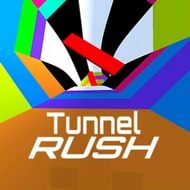
In Tunnel Rush you start deep inside a rotating geometric tunnel with an obstacle already visible a few segments ahead, and by the time you’ve steered around it, the next one is already sliding into view — closer, faster, and leaving less room to react than the last.
Movement is limited to four directions — up, down, left, right — sliding your position around the inside wall of a constantly spinning, color-shifting tunnel. Spikes and solid wall segments block sections of the path, and your only job is keeping your position clear of whatever’s occupying the space you’re about to fly into.
Why the Tunnel’s Rotation Matters as Much as the Obstacles
The tunnel itself rotates independently of your movement, which means a safe position can become a blocked one purely because the tunnel turned, not because you moved into danger. Players who ignore the rotation and focus only on obstacle shapes tend to get caught by spikes that were never actually in their path until the tunnel spun them there.
Speed increases are the real difficulty curve, not obstacle complexity. The obstacle patterns in Tunnel Rush don’t get meaningfully more intricate as a run continues — what changes is how little time you have to react to the same handful of shapes, which is why runs that felt comfortable early can fall apart entirely once the pace crosses a certain threshold.
Building the Rhythm to Read Tunnel Rush
There’s a rhythm to reading the tunnel that experienced players describe more than they can fully explain — anticipating rotation a half-second before it happens, rather than reacting to obstacles only once they’re already close. That anticipation is built entirely through repetition, since the game gives no explicit cue for when the tunnel is about to turn.
- Does Tunnel Rush ever slow back down during a run? No — speed climbs continuously for the duration of a run, with no reset point until the run itself ends.
- Is there an advantage to staying near the center of the tunnel? Generally yes, since a central position leaves more room to react in any of the four directions compared to starting a dodge from an already-extreme position.
By the time a run in Tunnel Rush ends, the tunnel is usually spinning fast enough that the wall you clipped barely registered before it was already over — which is exactly the kind of ending that makes restarting immediately feel less like a choice and more like a reflex.
Comments
There are no reviews yet. Be the first one to write one.