


-
Hide and Luig
-
Meccha Hunt
-
Fruit Ninja
-
Toaster Dash
-
Meccha Chameleon 3
-
Meccha Chameleon 2
-

Water Color Sort
-
Stickman Chameleon
-
Paint to Hide!
-
Paint&Seek Online
-
Meccha Obby
-

Paint or Seek: Chameleon Hide Online
-
Hide ‘N Seek!
-
Paint Strike
-
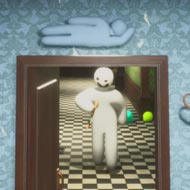
Meccha Chameleon Mobile
-
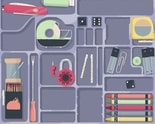
A Little to the Left
-

Among Us
-

Stickman Hook
Click To Continue




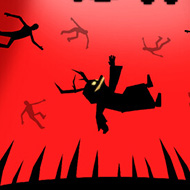


Five red, faceless figures are closing in from three directions in Click To Continue, and you’re unarmed in the middle of the room — but nothing moves until you do, which means the five-on-one that should have killed you in half a second is actually a puzzle you have all the time in the world to solve.
| Genre | First-Person Shooter / Puzzle |
| Core Mechanic | Time moves only when you move |
| Art Style | Minimalist white, black, and red |
| Platform | Browser (WebGL) |
That’s the entire premise of Click To Continue in one sentence: time is tied directly to your own motion. Stand still and the world freezes around you, including every bullet already in the air. Move, and everything moves with you, at the same speed you do. It turns a normal first-person shooter into something closer to a slow-motion chess match you’re playing in real time, one careful step at a time.
Reading a Room Full of Red Enemies
The red, crystalline enemies that fill each level shatter into fragments the instant they’re hit, and because they only act when you act, a room that looks like certain death from the doorway is really a sequence you can plan out piece by piece — who to disarm first, which thrown object clears a path, which direction to step to avoid a bullet that’s technically already been fired but hasn’t reached you yet.
- Firearms picked up directly from disarmed or defeated enemies
- Melee weapons, including bladed weapons that drop from certain encounters
- Thrown objects — bottles, mugs, or whatever’s sitting in the room — usable as improvised, one-hit takedowns
Weapons in Click To Continue are never something you carry between rooms. Every level hands you nothing and dares you to use the environment and the enemies themselves as your arsenal, which means the same room can be solved a dozen different ways depending on what you grab first and in what order.
The Puzzle Hiding Inside the Shooter
What separates Click To Continue from a normal bullet-time shooter is that the “time only moves when you move” rule turns every encounter into information you can study. A bullet frozen mid-air isn’t a threat yet — it’s a marker showing you exactly where not to step next, and reading the room that way, rather than reacting on reflex, is the actual skill the game is teaching.
- Does standing still actually stop time completely? Effectively yes — enemies, bullets, and thrown objects all freeze when you’re not moving, which is what makes it possible to plan a five-enemy room without ever being in real danger while you think.
- Can you replay a level after clearing it? Yes, and returning to a cleared level to solve it faster or with fewer wasted movements is a common way players push their understanding of the mechanic further.
The Minimalist Look Isn’t Just Style
The stripped-back white, black, and red visual language in Click To Continue isn’t decoration — it’s information. A world rendered in flat white with black outlines makes every red enemy and every red bullet trail immediately readable at a glance, even in a chaotic room with multiple threats converging at once. Strip away the color coding and the same room would be genuinely hard to parse; with it, even a five-enemy encounter stays legible enough to plan through calmly.
That legibility matters more here than in almost any other shooter, because the entire mechanic depends on you being able to read a frozen scene accurately. A bullet’s trajectory, an enemy’s raised weapon, a thrown object mid-flight — all of it has to be instantly parseable, and the minimalist art style exists specifically to make sure it is.
Momentum Without Time Pressure
What’s unusual about Click To Continue compared to most action games is that momentum and pressure are entirely decoupled. You can stand motionless in the middle of a room full of frozen threats for as long as you want, planning a route with zero real-time cost, and the instant you commit to moving, everything resumes at exactly the pace you set. That combination — total planning freedom paired with real, physical consequences the moment you act — is what makes clearing a room feel like solving a puzzle rather than surviving an encounter.
It also means skilled play looks completely different from panicked play. A player under pressure tends to move constantly, which speeds up every enemy and bullet in the room right along with them. A player who’s learned to trust the mechanic instead moves in short, deliberate bursts — a step to dodge, a pause to reassess, another step to close distance — treating the room less like a shootout and more like a sequence of small, solvable puzzle states.
Why Replaying a Cleared Room Teaches More Than the First Clear
The first time through a room in Click To Continue, success often comes from a slow, cautious route that barely works. Going back afterward to find a faster, cleaner solution — fewer wasted movements, a more efficient weapon pickup order — is where the mechanic really starts to click, since it forces you to see the room as a fixed puzzle with an optimal solution rather than a threat to simply survive once.
By the time you’ve cleared a room using nothing but a thrown mug and a gun taken from the second enemy you disarmed, Click To Continue has made its point clearly: the danger was never the enemies moving fast. It was always about whether you were willing to move at all.
Comments
There are no reviews yet. Be the first one to write one.