


-
Hide and Luig
-

Meccha Hunt
-
Fruit Ninja
-

Toaster Dash
-
Meccha Chameleon 3
-

Meccha Chameleon 2
-

Water Color Sort
-
Stickman Chameleon
-
Paint to Hide!
-
Paint&Seek Online
-
Meccha Obby
-

Paint or Seek: Chameleon Hide Online
-
Hide ‘N Seek!
-

Paint Strike
-
Meccha Chameleon Mobile
-

A Little to the Left
-

Among Us
-

Stickman Hook
2048









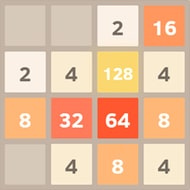
You slide every tile on the board to the right, watch two 8s collide into a single 16, and immediately realize you’ve just boxed yourself into a corner you’ll spend the next ten moves trying to undo. That’s 2048 in miniature — every move looks harmless until three moves later, when it isn’t.
| Genre | Puzzle |
| Grid Size | 4×4 |
| Goal | Merge tiles to reach the 2048 tile |
| Controls | Arrow keys or swipe |
Every move slides all tiles on the grid in one direction, and any two tiles carrying the same number merge into a single tile worth their sum when they collide. After each move, a new tile — either a 2 or a 4 — spawns in an empty space, which means the board never gets easier to manage the longer a run continues.
Why Corner Control Matters More Than Big Merges
Keeping your highest-value tile locked in a corner is worth more than any single big merge. A board where the biggest tile sits in a corner, surrounded by descending values, stays manageable far longer than one where the biggest tile ends up stranded in the middle, since a stranded high-value tile blocks merges on every side rather than just two.
The mistake most new players make is chasing whatever merge is available in the moment, sliding in whatever direction produces the biggest immediate combination. That approach works early, when the board is mostly empty, and falls apart later, once nearly every space is filled and a careless slide can lock a high-value tile away from anything it could merge with.
Reading the Board Two Moves Ahead
2048 rewards thinking past the immediate slide — not just what merges now, but what the board looks like after the new tile spawns and where it’s likely to land. A move that clears space but destroys your corner arrangement often costs more than it gains, even when it produces a satisfying merge in the moment.
- Is there a strategy better than just merging whatever’s available? Yes — committing to one corner for your highest tile and building descending values around it consistently outperforms chasing whichever merge looks biggest in the moment.
- What usually causes a game over in 2048? A full board with no adjacent matching tiles left in any direction, which typically happens after the corner strategy breaks down and high-value tiles end up scattered instead of stacked.
By the time a board is nearly full and every remaining slide feels risky, 2048 has quietly turned a simple number-matching idea into a genuine spatial puzzle — one bad slide away from a game over that was really decided several moves earlier.
Comments
There are no reviews yet. Be the first one to write one.