

















Dirt Clicker















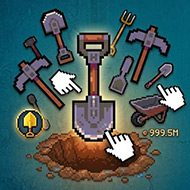
You start with one spoon and a patch of dirt, and nothing else. The first few digs in Dirt Clicker barely register as progress — a pixel of soil disappears, a number ticks up, and that’s it. Then the second dig happens, and the third, and somewhere around the tenth you realize the loop has already hooked you.
| Genre | Incremental / Idle Clicker |
| Platform | Windows |
| Setting | Fantasy, Nature |
| Core Loop | Dig, upgrade, hire helpers, go deeper |
The core mechanic of Dirt Clicker is deceptively plain: click to dig, spend what you find, dig faster next time. But the game layers a skill tree on top of that loop almost immediately, and this is where a lot of beginners get tripped up. Early points feel precious, so new players tend to hoard them instead of committing to a branch, which actually slows the digging rate more than spending too early would.
Helpers change the rhythm of the game entirely. Mushroom Buddies are the first hires most players unlock, and they’re cheap, slow, and forgiving — a good place to learn how automation interacts with manual clicking. Dirt Golems come later and hit much harder per action, while Druids add a support layer that boosts everything around them rather than digging themselves. Balancing these three types against each other is one of the quieter strategic layers in Dirt Clicker.
Reading the Layers Beneath the Surface
Progress in Dirt Clicker isn’t just deeper numbers — it’s structured around layers, each with its own texture of soil, its own pace, and its own rewards. By the time you reach the second layer, the spoon you started with is already a relic of an earlier phase of the run, and the game expects you to have upgraded your tool by then or digging will crawl to a stop.
Each layer hides relics and puzzle pieces alongside the more common loot. Some of these are purely collectible, sitting in a tally somewhere for completionists to chase. Others feed directly into unlocks, which means a player who rushes past a layer without exploring it can accidentally lock themselves out of upgrades that would have made the next layer easier.
This is the tension the game keeps returning to: move on quickly and stay ahead of the difficulty curve, or linger and mine a layer for everything it has. Neither approach is wrong, but they produce very different runs.
Upgrades, Spells, and the Skill Tree in Dirt Clicker
The skill tree governs almost every stat that matters — digging power, loot odds, worker efficiency — and it branches enough that two players can end up with meaningfully different builds. Some choices push toward raw digging speed, letting you brute-force through early layers on manual clicks alone. Others invest heavily in automation, accepting a slower start in exchange for a setup that mostly runs itself later.
Spells sit at the more experimental end of the tree. A few of them are described in the game as being powerful enough to break the intended pace entirely, which is an odd thing for a game to admit about its own systems, but it’s also honest — some of the spell combinations do let you skip past friction that other players have to grind through the long way.
Tracking Progress Without Losing the Plot
Dirt Clicker keeps a running set of stats on your helpers, including which ones are pulling their weight and which ones are effectively idle. It’s a small feature, but it matters once you have several Mushroom Buddies, a Dirt Golem or two, and a Druid all running at once, because it’s easy to lose track of who’s actually contributing to the dig.
Badges reward specific milestones rather than just raw progress, which nudges the game toward experimentation instead of pure number-chasing. A player optimizing purely for depth will miss some of these entirely, while a completionist digging through every corner of every layer will pick most of them up along the way.
What New Diggers Usually Get Wrong First
The most common early mistake is treating the spoon as a permanent tool instead of a placeholder. It works for the opening minutes, but it’s slow enough that sticking with it past the first real upgrade point noticeably drags down how quickly the skill tree opens up.
What happens if I ignore the skill tree in Dirt Clicker?
You can still dig manually and make some progress, but automation and digging power both scale through the tree, so ignoring it means every layer takes disproportionately longer to clear than it needs to.
Do the different helper types in Dirt Clicker actually matter?
Yes — Mushroom Buddies, Dirt Golems, and Druids each fill a different role, and a setup built entirely around one type tends to hit a wall that a mixed team avoids.
Is there a point to fully exploring each layer instead of moving on?
Layers hide relics and puzzle pieces that feed into unlocks, so fully exploring one before moving deeper can make the following layer noticeably easier to handle.
Dirt Clicker never pretends to be more than a game about digging, hiring, and upgrading, but the way those three systems interact — a Dirt Golem carrying weight while a Druid boosts it, a relic tucked into a corner of layer two that unlocks a spell you needed three layers ago — is what keeps players coming back to click one more time.
Comments
There are no reviews yet. Be the first one to write one.