


-

Hide and Luig
-

Meccha Hunt
-

Fruit Ninja
-

Toaster Dash
-
Meccha Chameleon 3
-

Meccha Chameleon 2
-

Water Color Sort
-
Stickman Chameleon
-
Paint to Hide!
-

Paint&Seek Online
-
Meccha Obby
-

Paint or Seek: Chameleon Hide Online
-

Hide ‘N Seek!
-

Paint Strike
-

Meccha Chameleon Mobile
-

A Little to the Left
-

Among Us
-

Stickman Hook
Subway Runner







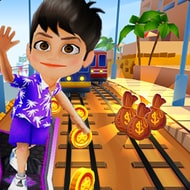
In Subway Runner you start at full speed — the train is already coming, the tracks are already there, and the gap between you and the barrier ahead closes faster than you expect on the first run. There is no tutorial, no warmup section, no gentle introduction to what jumping over trains and sliding under barriers feels like. Subway Runner assumes you know this genre and drops you into the lane-switching, coin-collecting, obstacle-dodging loop immediately. Whether that assumption is correct determines whether your first run lasts ten seconds or two minutes.
Lanes, Obstacles, and the Constant Sprint
Subway Runner’s playing field is three parallel track lanes. The character runs forward automatically; swipe left or right to change lanes, swipe up to jump, swipe down to slide. These four inputs are the entirety of the control vocabulary, and Subway Runner uses them to generate every obstacle scenario in the game. A train blocking one lane forces a lane change. A low barrier requires a slide. A gap in the track surface requires a jump. Barriers requiring a duck combined with a moving train in the adjacent lane require both inputs in sequence.
The obstacle generation in Subway Runner is designed to punish passivity. Standing in one lane for too long guarantees an obstacle in that lane — the game reads player behavior and accelerates threats toward comfort zones. Players who establish a preference for the center lane find the center lane rapidly filling with trains and low barriers. Keeping all three lanes in active rotation is both a strategic correct choice and a survival requirement.
Speed increases as the run extends. Early runs operate at a pace where most obstacles are visible with a reaction window of one to two seconds. After two or three minutes of continuous running, the approach speed compresses that window to less than a second for some obstacle types. The game’s difficulty curve is almost entirely encoded in speed — the same obstacles appear at higher run lengths but at a speed that demands faster processing and execution of the same inputs.
Coins and the Upgrade Loop
Coins scatter across the tracks in Subway Runner and are collected by running through them. They appear in linear strings — running straight through a coin line is more efficient than weaving — but coin lines sometimes pass through occupied lanes, requiring a detour that accepts a lane change and a shorter coin collection. The trade between optimal coin collection and obstacle avoidance is the core micro-decision of each run.
Accumulated coins unlock power-ups and extend the duration of booster items. Magnet power-ups pull coins from adjacent lanes, effectively tripling collection without requiring lane changes. Jetpack power-ups grant brief periods of flight above the tracks, during which obstacles are irrelevant and coin collection is unimpeded. Score multiplier power-ups double the distance points generated during their active window. All three power-up types are time-limited, and experienced Subway Runner players prioritize the jetpack as the single highest-value power-up because it removes all collision risk for its duration.
Character unlocks in Subway Runner change the visual of the runner without altering hitbox size or movement speed. Cosmetic progression is the standard approach in this genre, and Subway Runner follows it faithfully — the runner you play as is a style choice, not a mechanical one. The distinction matters to players who want to understand whether unlocking a new character is a meaningful gameplay decision.
Boosters and How They Stack
Active boosters in Subway Runner do not pause the obstacle generation or slow the track speed — they modify what the player can do during their active window. Magnet active means coins come to you; the track speed and obstacle density remain unchanged. Jetpack active means collision is suspended above the track; the lane below still fills with trains and barriers that will matter when the jetpack ends. Score multiplier active means every meter of distance is worth double; nothing else changes.
Stacking boosters is the highest-skill play in Subway Runner. Collecting a score multiplier and then immediately picking up a jetpack creates a window where points accumulate at double rate while no obstacles can interrupt the run. The timing of power-up collection to maximize stack overlap is subtle — players who collect power-ups as soon as they appear rather than holding position for a second power-up forgo the combination benefit. Advanced Subway Runner players learn which power-up combinations appear in proximity and time their collection to maximize the overlap window.
The hoverboard item functions differently from other boosters. Rather than a timed benefit, the hoverboard provides one free crash — the player runs into an obstacle without ending the run. After absorbing the crash, the hoverboard breaks and disappears. Starting a run with an active hoverboard is considered the standard for any serious Subway Runner distance attempt, because the one-crash insurance allows aggressive play through obstacle-dense sections that would otherwise demand caution.
Distance Records and How Players Chase Them
Subway Runner’s primary scoring metric is distance — meters or distance units accumulated in a single continuous run. Personal bests are the internal benchmark; top scores in visible leaderboards are the competitive benchmark. Early players celebrate crossing the 1,000-meter threshold; experienced players consider 10,000 the floor of a genuinely skilled run. The distance between those thresholds represents the gap between “knows the controls” and “has internalized obstacle timing and lane rotation.”
The community consensus on what kills most Subway Runner distance attempts: unexpected double-obstacle configurations. A train in the left lane combined with a low barrier in the center lane appears suddenly at high speed and gives the player exactly one valid choice — slide in the right lane — with essentially no reaction time. Players who encounter this configuration for the first time almost always fail it. The second time, they recognize the visual pattern. By the fifth time, the slide input has become automatic. The gap between first encounter and automatic response varies by player but is the most significant skill development in Subway Runner.
High-distance runs in Subway Runner have a specific feel that experienced players describe as “flow state” — the obstacles stop feeling like individual decisions and start feeling like a single rhythm that the player executes without conscious thought. The lane changes, jumps, and slides happen faster than deliberate thought can process them, driven by pattern recognition that has been compressed into reflex. This flow state is what keeps long-time Subway Runner players returning — it is genuinely pleasurable in a way that early, deliberate play is not.
What Subway Runner Players Criticize
The obstacle repetition in Subway Runner is the most consistent criticism from players who spend extended time with it. The game’s obstacle library is not small, but at high run durations, pattern combinations start repeating in recognizable sequences. Players who have played enough Subway Runner to develop full obstacle recognition sometimes report the experience shifting from reactive to predictive — they know a train-barrier combination is coming before it appears, which removes the core challenge. The game does not add truly new obstacle types after a certain distance threshold, meaning the later portions of long runs are survived by mechanics already learned rather than new skills developed.
Hitbox consistency is the second complaint. Players who slide under a barrier and die despite appearing to have cleared it describe the hitbox as “invisible” — the visual clearance suggests a safe passage that the collision detection does not agree with. This is partly a consequence of running at high speed on small screens, where the visual margin for error looks larger than the mechanical margin. The community’s consensus is that the hitbox is technically accurate but the visual representation of safe clearance at speed is misleading.
- Does Subway Runner have an ending? No. Like most endless runners, Subway Runner has no defined finish line or maximum score. The run ends when the player collides with an obstacle without a hoverboard active, at which point the final distance is recorded as the session score. The game is designed as a personal-best chase rather than a completion challenge — there is always a higher distance to reach.
- What is the best strategy for collecting coins early in a run? In the early run phase when speed is low, coin collection should take priority over caution because the reaction time available is sufficient to handle the obstacle generation even while chasing coin lines. As speed increases, the priority reverses — obstacle avoidance should dominate, with coin collection only when a line is in the current lane with no obstacle conflict. Aggressive early-run coin collection funds the power-up upgrades that make later-run survival more consistent.
- Do characters affect gameplay in Subway Runner? Visually yes, mechanically no. Each unlockable character has the same hitbox dimensions, the same movement speed, and the same control response as the default character. Character selection in Subway Runner is a purely cosmetic choice — the reason to unlock characters is visual preference or completion, not performance advantage. This is consistent across all versions of the game the community has tested.
Subway Runner does what it sets out to do well: it puts a runner in a lane-switching obstacle course and lets the speed carry the tension. The booster stack mechanic adds a thin strategy layer over the reflex foundation. The coin upgrade loop gives short-session players a sense of progress that pure distance chasing does not always deliver. Players who have grown past the genre’s basics will find the ceiling low; players who want their reflexes tested in a clean, immediate format will find Subway Runner holds that format faithfully for longer than most similar games justify.
Comments
There are no reviews yet. Be the first one to write one.