


-

Hide and Luig
-

Meccha Hunt
-
Fruit Ninja
-

Toaster Dash
-
Meccha Chameleon 3
-

Meccha Chameleon 2
-

Water Color Sort
-
Stickman Chameleon
-

Paint to Hide!
-

Paint&Seek Online
-
Meccha Obby
-

Paint or Seek: Chameleon Hide Online
-
Hide ‘N Seek!
-

Paint Strike
-

Meccha Chameleon Mobile
-

A Little to the Left
-

Among Us
-

Stickman Hook
Blob Drop








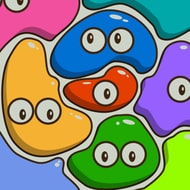
The drop counter in Blob Drop reads 47 and you still have six colors queued. That specific number matters because each blob you have dropped without clearing a match has added weight to the pile below, and the pile is now three tiles from the top boundary. Blob Drop does not announce when the game is ending — it just keeps dropping blobs and the pile keeps rising, so the moment of failure arrives the same way an actual avalanche does: faster than you expected, slower than it should have been obvious.
How Blobs, Colors, and Matches Work
Blob Drop operates on a grid where colored blobs fall from the top and stack on whatever surface is below them. When three or more blobs of the same color form a connected group — horizontally or vertically adjacent — they pop and are removed from the grid. The blobs above the cleared group fall to fill the gap, which can trigger chain reactions if the new arrangement creates another matching group. Chain reactions are the game’s primary scoring mechanism and the main reason Blob Drop rewards patience over speed.
The incoming queue shows the next two or three blobs before they drop, giving players enough information to plan where each should land. The drop point is controlled by moving a cursor horizontally across the top of the grid — left or right, one column at a time — and confirming the drop. The blob falls straight down and stacks on the highest occupied tile in that column. This column-based mechanic means that choosing the wrong column at the wrong time can bury a needed color under a pile of mismatched blobs, blocking it from participating in a future match.
Special blob types appear as levels progress. Bomb blobs clear a small radius around their landing point regardless of color. Stone blobs cannot be matched and do not pop — they only move when blobs beneath them are cleared, at which point they fall into the gap. Rainbow blobs match any color adjacent to them and trigger the largest chain reactions of any single blob type. Managing stone blobs is the primary skill test in later Blob Drop levels, because a stone blob that settles in a central column can block matching paths across the entire grid.
Chain Reactions and How to Build Them
A chain reaction in Blob Drop starts when a cleared group causes the blobs above to fall and form a new matching group, which clears and causes another fall, and so on. A two-stage chain doubles the base score. A four-stage chain multiplies it by eight. Players who chase chain reactions consistently score three to four times higher than players who clear single groups as they appear, which makes the chain mechanic not just a bonus but the core of competitive play.
Building a chain requires holding colors in reserve rather than clearing them immediately. If you have a cluster of four green blobs and a path to extend that cluster to six by dropping two more greens onto it, the resulting clear may land a yellow blob next to an existing yellow group, triggering a second pop. Most players learn to read these setups three or four blobs in advance. Trying to plan further than that becomes unreliable because the queue only shows the next few blobs, and deeper prediction requires guessing colors that haven’t been revealed.
The most consistent chain setup strategy in Blob Drop involves building two parallel color concentrations in adjacent columns. Drop one color into the left column until it forms a nearly-complete group, then drop the trigger color that completes it — which falls, clears, and allows the right column’s group to touch something it was separated from before. This column-pair technique generates reliable two-stage chains and is the first setup method most experienced Blob Drop players learn to execute deliberately rather than by accident.
Why Beginners Lose to the Pile
New Blob Drop players lose because they clear too eagerly. Seeing a three-blob match and popping it feels productive, but each premature clear uses a drop that could have positioned the same blob for a more valuable chain. The pile grows at a fixed rate — one blob per turn — and the only way to stay ahead of it is to clear more blobs per turn than the rate of growth, which requires chains rather than single pops.
The second common beginner error is ignoring column balance. Players who favor certain columns end up with tall towers on one side and shallow stacks on the other. A tall tower in one column blocks the ability to drop blobs there without stacking them past the danger zone, while the shallow columns waste potential matching space. Keeping columns at roughly equal heights gives the most flexibility for incoming blobs and prevents any single column from becoming a liability.
Stone blobs catch new players completely off guard. Most casual puzzle games either explain their obstacle mechanics or introduce them gradually; Blob Drop drops a stone blob into the middle of the grid with no warning and waits to see how the player responds. Players who understand that stone blobs fall when cleared beneath are fine; players who try to match them like regular blobs waste moves and usually accelerate the pile’s rise. The stone blob reveal is the game’s first genuine difficulty spike and the point at which players either adapt or quit.
What Experienced Players Find Controversial
The queue visibility in Blob Drop is the game’s most contested element. Showing only the next two or three blobs means that deep planning is cut off by information limits. Some players argue that a longer queue — five or six blobs visible — would allow for more sophisticated setups and make the game feel more strategic. Others counter that longer queue visibility would reduce the surprise that makes Blob Drop feel different from fully-deterministic puzzle games. The disagreement reflects a genuine tension between two types of puzzle game players, and the current queue length sits closer to the casual end of that spectrum.
Score inflation through chain-chasing also generates discussion. Players who deliberately set up long chains before clearing create towering piles that come dangerously close to the top boundary while the setup is in progress. This risk-reward tradeoff is considered healthy by most, but newer players watching experienced Blob Drop runs describe the pile height during a chain setup as “terrifying” — the visual stress of the rising stack is real even when the player is in control of the situation.
Blob Drop’s visual design deserves mention. The rounded, slightly translucent blobs with soft shadows were specifically praised by players in early community discussions as a reason the game felt pleasant to interact with beyond pure mechanics. Puzzle games live and die on tactile feel — the click of clearing a group in Blob Drop hits cleanly enough that players report enjoying the sound design as part of the reason they return.
Comments
There are no reviews yet. Be the first one to write one.