



-

Hide and Luig
-

Meccha Hunt
-

Fruit Ninja
-

Toaster Dash
-
Meccha Chameleon 3
-

Meccha Chameleon 2
-

Water Color Sort
-

Stickman Chameleon
-

Paint to Hide!
-
Paint&Seek Online
-

Meccha Obby
-

Paint or Seek: Chameleon Hide Online
-

Hide ‘N Seek!
-

Paint Strike
-

Meccha Chameleon Mobile
-

A Little to the Left
-

Among Us
-

Stickman Hook
Paint&Seek Online












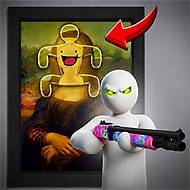
You crouch beside a paint-streaked armchair, nudge your color slider toward the exact shade of the cushion behind you, and freeze the instant footsteps round the corner. That half-second of not knowing whether the disguise held is the entire appeal of Paint&Seek Online, a game where hiding is never as simple as finding a corner and staying quiet.
| Genre | Multiplayer hide-and-seek |
| Platform | Browser |
| Team Roles | Hiders and Seekers |
| Core Tool | Color-matching paint system |
Painting Yourself Into the Environment
The premise sounds simple until you’re actually standing next to a sofa trying to decide whether your green is warm enough to match the fabric. Paint&Seek Online hands every Hider a color palette and expects them to sample the room around them rather than just duck behind a box. You’re not hiding an object behind another object here — you’re trying to become the object, which changes how you think about every surface in a level. A wall isn’t just cover anymore; it’s a color you need to replicate convincingly. Doorframes, crates, potted plants, even patches of floor all become candidates once you realize the game rewards accuracy over speed.
New players almost always undershoot how picky the Seekers’ eyes get by the second round. A close-enough color reads fine at a glance but falls apart the moment someone stops and really looks.
Common Mistakes Hiders Make Early On
The first mistake is treating this like ordinary hide-and-seek and picking a spot based on how well it’s tucked away rather than how well it can be painted. A perfectly concealed corner does nothing if the surface behind you is a busy pattern your palette can’t reproduce. The second mistake is moving too soon. Plenty of rounds are lost in Paint&Seek Online not because the paint job was bad, but because a Hider shifted their weight or turned to check on a nearby Seeker, breaking a disguise that would have otherwise held.
- Picking flat, single-color surfaces over patterned ones, since the game’s paint tool blends best against solid backgrounds
- Committing to a spot early instead of scouting two or three options before a round starts
- Ignoring lighting differences between shaded corners and open floor, which change how a color actually reads
Players who treat scouting as part of the round, not a wasted step before it, tend to survive longest.
Thinking Like a Seeker in Paint&Seek
Seekers in Paint&Seek Online aren’t chasing movement so much as chasing inconsistency. Anyone who’s spent real time on the Seeker side starts noticing that most hiding spots have a slightly wrong edge, a color that’s close but not quite blended into the grain of the wood behind it. Competitive players in the community talk about doing a “camo check” — walking a room slowly instead of sprinting through it, because sprinting misses exactly the kind of subtle mismatch that gives a Hider away. A methodical Seeker who checks every suspicious surface will usually out-perform a fast one who only glances at the obvious spots.
Players who enjoy the analytical side of party games tend to gravitate toward Seeker rounds, where pattern recognition matters more than reflexes.
Why a Good Paint Job Still Isn’t Enough
Even a near-perfect color match won’t save a Hider who picked a bad location relative to where Seekers naturally walk first. Early in a match, most Seekers beeline toward furniture and large objects, since that’s where hiding instinct usually points less experienced Hiders. That means the most “obvious” hiding spots get checked fastest, while overlooked corners — a stretch of wall by a doorway, a patch of floor nobody expects — often survive longer purely because nobody bothers to look there first. This is where Paint&Seek Online rewards creativity over caution, and it’s also the aspect players argue about most: some feel the best hiding spots are found through genuine cleverness, while others think a handful of overused corners get abused every match, making rounds feel repetitive once you’ve played enough of them.
That tension between creative freedom and repeatable “meta” spots is one of the more honest criticisms you’ll find in community discussions about the game.
What’s the best strategy for beginners in Paint&Seek Online?
Focus on color accuracy before location. A well-matched paint job on a mediocre spot beats a great hiding spot with a sloppy color match, since Seekers are trained to spot mismatches first and empty space second.
Can Seekers tell the difference between a real object and a painted Hider?
Usually yes, if they slow down. Painted Hiders rarely replicate texture perfectly, so surfaces that look flat or slightly too smooth compared to their surroundings are the most common tell experienced Seekers rely on.
Does movement always break a disguise in Paint&Seek Online?
Any noticeable shift does, whether it’s turning to peek at a Seeker or repositioning mid-round. Staying completely still, even when a Seeker walks close by, is usually the safer choice than trying to relocate.
Paint&Seek Online works because it turns something as simple as color-matching into a genuine mind game between Hiders and Seekers, and rounds rarely play out the same way twice once players start experimenting with less obvious spots. Whether you’re carefully blending into a doorframe or running a slow camo check as a Seeker, the game keeps rewarding patience over panic.
Comments
There are no reviews yet. Be the first one to write one.