


-

Hide and Luig
-
Meccha Hunt
-
Fruit Ninja
-
Toaster Dash
-
Meccha Chameleon 3
-

Meccha Chameleon 2
-

Water Color Sort
-
Stickman Chameleon
-

Paint to Hide!
-

Paint&Seek Online
-
Meccha Obby
-

Paint or Seek: Chameleon Hide Online
-

Hide ‘N Seek!
-

Paint Strike
-

Meccha Chameleon Mobile
-

A Little to the Left
-

Among Us
-

Stickman Hook
Lexispell









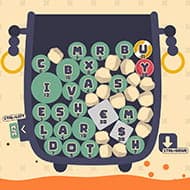
What happens when the cauldron overflows in Lexispell is not a dramatic animation — it is just the end of your run, quiet and immediate, and it is completely your fault. That single consequence powers the whole game. Lexispell is a roguelike word game built on a physics-driven cauldron full of floating letter bubbles. Matching letter bubbles merge and grow, Suika-style, raising their point value. You drag letters together, form real words, submit them for score, and choose upgrades between rounds. The hook is that the cauldron has limited space, and every bell ring that drops new letters costs you room you may not have.
| Genre | Roguelike word / puzzle |
| Platform | PC (Steam), browser (itch.io) |
| Modes | Classic Craft, Letter Rush, Jar Puzzle, Daily Challenge |
| Main mode length | 12 rounds with boss every 3rd round |
The Cauldron, the Merge, and the Bell
Classic Craft is the core mode. You clear 12 rounds by hitting a score threshold each time, with no timer putting pressure on you. Every third round is a boss fight, and Lexispell has over 20 bosses total, each arriving with a rule that disrupts your scoring. One removes all points from vowels. Another shrinks the letter pool. One boss mid-run throws out the rules entirely, requiring every valid word to repeat a single letter — which tends to catch players off guard the first time it fires, especially if they have been building toward a vowel-heavy upgrade build.
The merge mechanic is where Lexispell earns its Balatro comparison. As identical letter bubbles touch and fuse, the resulting larger bubble scores more. A word built with merged, high-value letters outscores the same word spelled with individual tiles. This means early game decisions about which letters to merge before committing to a word have downstream effects on your scoring ceiling. You can equip up to 10 scrolls, 6 runes, and 3 items per run, and a letter-multiplier scroll plays very differently depending on whether you have been husbanding your merged tiles or spending them quickly.
Letter Rush flips the patience of Classic Craft entirely. Letters drop continuously and the cauldron fills whether you are ready or not. Players who approach it the same way they approach Classic Craft — reading carefully, planning merges — get buried. The mode rewards fast word recognition over optimal scoring, and the community largely treats it as a separate skill from the main mode.
What Beginners Get Wrong in Lexispell
The bell is the most misused tool in early play. New players ring it the moment they run low on useful letters, not realizing that adding more tiles raises the overflow risk when the cauldron is already crowded. Experienced players treat the bell as a last resort, not a first instinct. The Jar mode — where the cauldron fills once at the start and no new letters arrive — is actually the best place to develop restraint, because it makes the fixed letter economy visible in a way Classic Craft does not.
Rune selection in the shop is another point where early Lexispell runs fall apart. Runes influence which letters spawn in the cauldron, and buying runes that favor consonant clusters when your scrolls reward long words with lots of vowels creates a build that contradicts itself. Players who reach the later rounds consistently tend to pick runes that reinforce their scroll synergy rather than runes that look powerful in isolation.
Boss Rounds and Advanced Scoring
By the time you reach round 9 in Classic Craft, the score threshold stops being about vocabulary and becomes resource management — when to use a wand to change a letter, when to burn a potion, when to hold for an 8-letter word to trigger the 3x multiplier rather than take safer shorter words. The game’s highest-scoring strategies involve stacking passive scrolls that activate on specific word lengths or letter types, then building words that hit multiple triggers at once. Players in the Lexispell community call this a combo chain, and finding a build that clicks is the moment the game reveals its actual depth.
One honest limitation players raise: the base game on standard difficulty is not terribly hard. The three difficulty settings inflate the score thresholds, and the highest setting pushes the boss rounds into genuine tension, but casual players can reach round 12 fairly reliably on a default run without deep build knowledge. The endless mode, which continues after round 12 with exponentially rising quotas and a separate leaderboard, is where the ceiling actually appears.
Frequently Asked Questions About Lexispell
What is the difference between scrolls and runes in Lexispell?
Scrolls are passive upgrades equipped to your run that affect how words score — for example, multiplying points from long words or from words containing specific letters. You can hold up to 10 scrolls at once. Runes are purchased from the shop to influence which letter types appear in the cauldron, shaping the pool of tiles you draw from. The two systems work best when they reinforce each other: runes that spawn letters your scrolls reward are the foundation of a strong Classic Craft run.
Can you play Lexispell without a keyboard?
Yes. Lexispell supports mouse, keyboard, touchscreen, and controller input. The browser version on itch.io plays fully with mouse dragging, which makes it accessible without typing. Players sensitive to the background camera drift effect can disable it in the settings menu, a quality-of-life option the community flagged and the developer added.
What does the Jar mode do differently from Classic Craft?
In Jar Puzzle mode, the cauldron fills once at the start with a fixed set of letters and no new tiles are added. You score as many words as possible from that closed pool before it runs dry. There is no bell, no overflow risk, and no roguelike round structure. Players who find Classic Craft too chaotic use Jar mode to study merge patterns and word construction without time or space pressure — it plays closer to a contained word puzzle than a roguelike.
Lexispell sits in a specific niche: it is genuinely cozy in aesthetic and soundtrack — composer Trevron’s looping music holds up across long sessions — but the boss rules, rune choices, and multiplier timing give avid players something to optimize across runs. The moment a big merged letter bubble drops into place to complete a long word and a scroll chain fires is the one that keeps Lexispell players coming back, and the cauldron’s quiet overflow is the one they remember most.
Comments
There are no reviews yet. Be the first one to write one.