


-
Hide and Luig
-
Meccha Hunt
-
Fruit Ninja
-
Toaster Dash
-
Meccha Chameleon 3
-

Meccha Chameleon 2
-

Water Color Sort
-
Stickman Chameleon
-
Paint to Hide!
-
Paint&Seek Online
-
Meccha Obby
-

Paint or Seek: Chameleon Hide Online
-
Hide ‘N Seek!
-
Paint Strike
-
Meccha Chameleon Mobile
-
A Little to the Left
-
Among Us
-
Stickman Hook
Bubble Trouble



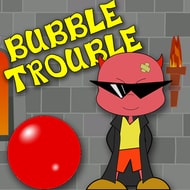
You line up under a bouncing sphere twice your height, tap the trigger, and watch the harpoon streak straight up before the bubble splits into two smaller ones falling on separate paths. That splitting moment is the entire skeleton of Bubble Trouble, and it’s why the game still gets brought up in browser-game nostalgia threads even though it looks almost primitive by modern standards.
| Genre | Arcade shooter / puzzle-action |
| Platform | Browser |
| Core mechanic | Pop bubbles with a harpoon before they touch you, managing the splits they leave behind |
| Levels | Multiple stages of increasing bubble count and speed |
How the Harpoon and Splitting Actually Work
The harpoon in Bubble Trouble only ever fires straight up, which sounds limiting until you realize the whole game is built around that restriction. You move left and right along the floor of the level, and your only offensive tool is a vertical shot that has to intersect a bubble’s current position at the exact height it’s passing through. Miss the timing and the bubble keeps bouncing while you reload for another attempt.
Every bubble you hit splits into two smaller bubbles that fly outward at an angle before they start bouncing on their own arcs. The smallest bubbles, often called the final-tier bubbles by players, pop for good instead of splitting again, which is the only way to actually clear a wave. Beginners tend to shoot the first thing that drops into range without checking where the resulting split bubbles will land, and that single habit accounts for most early deaths in the game.
Difficulty escalates less through new mechanics and more through density. Later stages throw four or five large bubbles into a compact arena at once, and the moment you split two of them simultaneously the screen fills with four smaller bubbles bouncing on overlapping timers. Reading which bubble is about to reach your height becomes the real skill, not the shooting itself.
Power-Ups That Change a Run
Bubble Trouble scatters a handful of power-ups that drop when certain bubbles pop, and knowing which ones to prioritize separates players who scrape through a level from players who clear it with room to spare.
- The Bomb power-up clears every bubble currently on screen, which is the closest thing to a panic button when a wave gets out of hand
- The Rapid-fire power-up shortens the cooldown between harpoon shots, letting you punish bubbles the moment they’re in range
- The Freeze power-up stops bubble movement for a few seconds, giving you a window to line up shots without dodging
Speedrunners and score-chasers in the community tend to disagree on the Bomb power-up specifically. Some treat it as an emergency reset that should be saved for the worst possible screen state, while others grab it immediately because a cleared board resets the level’s rhythm. Neither approach is wrong, but it’s one of the few genuinely divisive choices in a game this simple.
Reading a Level Before It Reads You
Once you reach the stages where three or more large bubbles spawn together, positioning starts to matter more than reflexes. Standing at the edge of the arena gives you more time to react to a falling bubble because you can retreat along one direction only, while standing in the middle exposes you to bubbles approaching from both sides.
Casual players usually camp near the center out of habit from other arcade games. Score-focused players hug the walls instead, using the extra half-second of reaction time to line up cleaner harpoon shots rather than panicked ones.
What Beginners Consistently Get Wrong
The most common mistake isn’t dying to a bubble that catches you off guard, it’s shooting a large bubble while standing directly beneath its landing zone. The split sends two smaller bubbles outward, but if your character hasn’t moved, one of those splits often lands right back on top of your original position within a second or two. Waiting an extra beat before firing, just long enough to confirm which direction you’ll dodge, fixes this almost immediately.
A second recurring error is treating every bubble the same size. A bubble two splits away from disappearing behaves completely differently from a fresh, full-size one dropped at the start of a wave, both in bounce height and in how much room you have before it reaches the floor. By the time you reach the stages with five or six bubbles active, misjudging bounce height is what actually ends most runs, not lack of shooting speed.
What happens when a bubble splits mid-air near a power-up?
The split bubbles simply continue on their new paths and can collide with a power-up icon on the way down, which usually destroys the icon before you can collect it. Players who track power-up drops closely learn to fire in a way that keeps splits away from the icon’s landing spot.
Why does Bubble Trouble feel harder with more bubbles on screen than in later levels with faster bubbles?
Sheer bubble count creates overlapping bounce timers that are genuinely harder to track than a smaller number of fast bubbles, since your brain has to predict multiple arcs at once instead of reacting to a single fast object. Most players report the multi-bubble waves as the actual difficulty spike, not the speed increases that come later.
Is there a way to guarantee a Bomb power-up drop?
No specific bubble is guaranteed to drop the Bomb power-up, and drops are tied to which bubbles you pop rather than a fixed schedule, so players generally treat power-up appearances as a bonus rather than something to plan a strategy around.
Bubble Trouble earns its lasting spot in browser-game memory not through complexity but through how tightly the harpoon-and-split loop rewards patience over panic. Watching a full screen collapse into nothing after a well-placed Bomb power-up, or threading a shot between two falling bubbles without needing it at all, is still the moment the game is best remembered for.
Comments
There are no reviews yet. Be the first one to write one.