


-
Hide and Luig
-
Meccha Hunt
-
Fruit Ninja
-
Toaster Dash
-
Meccha Chameleon 3
-
Meccha Chameleon 2
-

Water Color Sort
-
Stickman Chameleon
-
Paint to Hide!
-
Paint&Seek Online
-
Meccha Obby
-

Paint or Seek: Chameleon Hide Online
-
Hide ‘N Seek!
-

Paint Strike
-
Meccha Chameleon Mobile
-
A Little to the Left
-
Among Us
-
Stickman Hook
Bloxorz






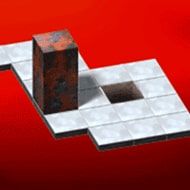
Why does a block that’s twice as long as it is wide make for such a genuinely difficult puzzle game? Because in Bloxorz, the block’s orientation — lying flat, standing upright, or balanced on one end — matters as much as its position, and the only way through most levels is understanding both at once.
You roll a rectangular block across a floating, tiled platform by tipping it end over end in any of four directions, and the goal on every level is the same: get the block to drop cleanly into a square hole exactly its width. That means the block has to be standing upright — vertical, not flat — the moment it reaches the hole, or it simply won’t fit.
Reading Orientation Before Every Move in Bloxorz
The block’s current orientation determines what’s actually safe to do next, not just where it’s sitting. A block lying flat can safely roll across a two-tile-wide path that would send a vertical block straight off the edge, which means planning a route through Bloxorz means tracking shape as carefully as position — the same tile can be safe or fatal depending entirely on how the block happens to be resting when it arrives there.
Orange switches toggle bridges elsewhere on the level, letting you open a path that wasn’t there when the level started — useful, but not always straightforward, since triggering one from the wrong orientation can leave the block stranded on the wrong side of the very bridge it just opened.
Splitters and the Trickiest Mechanic in Bloxorz
Later levels introduce splitters, which divide the single rectangular block into two smaller, separate pieces — each one now independently movable, and each one needing to reach specific tiles before the puzzle allows them to merge back together. Managing two pieces at once, rather than one, is where Bloxorz stops being a rolling puzzle and starts being a genuine spatial reasoning problem, since a mistake with one piece can strand it in a spot the other piece has no way to reach and rescue.
Heavy blue switches add one more wrinkle: some only trigger when the block is standing directly on top of them in its upright orientation, which means a route that looks efficient while the block is lying flat might need an extra, seemingly wasted move just to stand the block up over the right tile.
By the final levels, Bloxorz has stopped testing whether you can move a block from one point to another and started testing whether you can hold an entire shifting shape — position, orientation, and sometimes two separate pieces — in your head all at once, several moves before you actually commit to any of them.
Comments
There are no reviews yet. Be the first one to write one.