



-

Hide and Luig
-
Meccha Hunt
-

Fruit Ninja
-

Toaster Dash
-
Meccha Chameleon 3
-

Meccha Chameleon 2
-

Water Color Sort
-
Stickman Chameleon
-
Paint to Hide!
-
Paint&Seek Online
-
Meccha Obby
-

Paint or Seek: Chameleon Hide Online
-

Hide ‘N Seek!
-

Paint Strike
-
Meccha Chameleon Mobile
-

A Little to the Left
-

Among Us
-

Stickman Hook
Little Horrors: The Mortuary








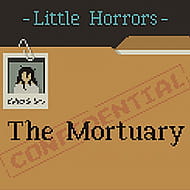
A phone rings in the middle of the night and drags you out of bed. Your employee is stuck somewhere he should not be, and the storeroom door will not budge on its own. Little Horrors: The Mortuary drops you straight into that call with no tutorial pop-up and no warm-up level, just a flashlight, a ring of keys, and a building that used to be quiet.
| Genre | Point-and-click horror adventure |
| Platforms | Windows, Linux |
| Average session | A few minutes |
| Primary controls | Left click to move and interact, right click to examine |
Waking Up to a Call in Little Horrors: The Mortuary
The setup is simple on paper. Someone at the mortuary is trapped in the storeroom, and you are the only one who can help. That premise is delivered through short, deliberately paced dialogue rather than exposition dumps, which fits the tone: this is a game about noticing small wrong details in a familiar place, not about reading lore. The pixel art keeps everything low-resolution, and that restraint does a surprising amount of the atmospheric work, letting shadows and silence carry scenes that higher-fidelity horror would try to solve with jump-scare stingers instead.
Beginners tend to rush the opening rooms because the interface looks like it belongs to a casual adventure game. It does not punish speed with a fail state, but it does reward slowing down. Objects respond differently depending on when you examine them, and the character mutters short reactions that change once certain story beats have triggered. Missing those lines does not break the game, but it flattens a run that is already short.
Players who go in expecting a puzzle-box mortuary with elaborate locks will be surprised at how linear the early sections actually are. The game is not hiding a maze behind the front door; it is hiding a mood, and that mood depends on players paying attention to the storeroom itself long before anything inside it starts to move.
Reading the Storeroom Before You Touch Anything
Once the storeroom becomes reachable, the pacing shifts. This is where the point-and-click mechanic actually gets tested, because success depends on examining objects in a sensible order rather than clicking everything at random. A few things worth doing before advancing:
- Examine every visible container in the storeroom, since some react only on a second look
- Pay attention to dialogue that repeats with slightly different phrasing
- Backtrack to earlier rooms if an interaction feels unfinished
Community discussion around Little Horrors: The Mortuary keeps circling back to this section, mostly because it is the point where the “slow burn” pacing that reviewers praise either clicks for a player or starts to feel like padding. Both reactions show up in comment sections regularly, and that split is one of the more honest things being said about the game right now.
What Mouse-Only Movement Actually Changes
There is no WASD option, and that decision has generated more discussion than almost anything else in the game. Some players find the mouse-driven movement true to the point-and-click genre it is imitating. Others, used to modern first-person horror, have said outright that clicking to walk across a room breaks their sense of urgency during tense moments. Both camps are playing the same short game and coming away with different readings of its pacing, which says something about how differently horror fans respond to control schemes.
The right-click examine function is where most of the writing lives. Left click moves the character and triggers the main sequence of events; right click pulls up the short, often dryly funny observations that give the mortuary its personality between scares.
Advanced players tend to right-click far more than they need to, purely because the payoff of extra dialogue is worth the extra seconds.
The Moment the Corpse Stops Being Still
By the time the corpse in the storeroom stops behaving like a corpse, the game has fully switched from setup to payoff. This is the single beat most viewers reference when describing the game to friends, and it works specifically because everything before it was so restrained. Nothing about the pixel art or the sound design escalates gradually toward that point; the shift is sudden, which is exactly the effect a short-form horror game needs when it only has one real twist to spend.
Once that scene plays out, the remaining minutes move quickly toward a conclusion built to leave players wanting the next chapter rather than a definitive close.
Questions Players Ask Before Starting Little Horrors: The Mortuary
How long does it take to finish?
Most players clear it in a single sitting of a few minutes, which matches its billing as a short entry rather than a full-length adventure game.
Is there more than one ending?
The current build is built around one story path through the storeroom and the events that follow, with no branching choices that change the outcome.
Will there be a sequel?
Two further chapters are planned, along with one final entry to close out the storyline, so this first mortuary visit is meant as an opening chapter rather than a self-contained piece.
Little Horrors: The Mortuary is not trying to be a long horror campaign, and judged on those terms it succeeds: a tight, mouse-driven story built around one storeroom and one very effective moment when the corpse inside it refuses to stay put.
Comments
There are no reviews yet. Be the first one to write one.