


-
Hide and Luig
-
Meccha Hunt
-
Fruit Ninja
-
Toaster Dash
-
Meccha Chameleon 3
-
Meccha Chameleon 2
-

Water Color Sort
-
Stickman Chameleon
-
Paint to Hide!
-
Paint&Seek Online
-
Meccha Obby
-
Paint or Seek: Chameleon Hide Online
-
Hide ‘N Seek!
-
Paint Strike
-
Meccha Chameleon Mobile
-

A Little to the Left
-
Among Us
-
Stickman Hook
Night at Nuggit’s




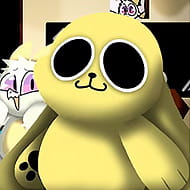
Night at Nuggit’s looks like a soft, hand-drawn cartoon about a floppy-eared dog and his fast-food-named friends, but it plays like a genuinely demanding survival horror game that expects you to track a dozen moving threats at once. That gap between what the art style promises and what the difficulty curve delivers is the first thing new players run into, usually around night three.
You take control of Licowice, an unidentified creature physically pulled into this world by a guide named Bezel, who explains early on that Chikn — the central figure of the game’s world — is a self-styled demigod bending everything around him to his whim. From there, the game settles into a twelve-to-six night-shift structure familiar to anyone who’s played a Five Nights at Freddy’s-style survival game, except every character here comes from the animated web series Chikn Nuggit rather than an animatronic pizzeria.
Licowice and the Cast of Night at Nuggit’s
The roster is enormous by the standards of the genre. Chee, Fwench Fwy, Iscream, Slushi, Sody, and Cofi all show up as the nights progress, and each one behaves differently depending on their relationship to the others — a mechanic the community refers to as Dynamic Mechanics. Two characters who are “friendly” toward each other in the game’s internal logic might pause their approach to let one another through first, while a rivalry between two others can make them both more aggressive at once.
This relationship system is what makes memorizing a single character’s pattern useless on its own. A strategy that works perfectly against Iscream on one night can fall apart the moment Cofi is introduced a few nights later, since their dynamic changes how often each one checks in on you. Long-time players of the game describe this as the real skill ceiling — not reaction speed, but keeping a mental map of which characters are currently reinforcing each other.
Old Pea and Worst Man round out some of the later-night additions, and cosmetic skins let you swap them for characters like Batrick the Bat, a nod to the developer’s other animated shorts. None of these swaps change behavior, but they do show up in death-screen sound bites, which players frequently clip and share since the voice work carries a lot of the game’s comedic tone even in its scariest moments.
Bezel Events and the Chaos Curve
Each night includes what the game calls Bezel Events — unscripted disruptions that can be as minor as a light flicker or as major as a full change to your available defenses partway through a shift. Once these start stacking on top of the character relationship system, a night that looked manageable at 1 AM can spiral by 4 AM without warning.
By the time you reach the later nights, chaos isn’t a side effect of the game, it’s the entire design philosophy. Nuggets, the in-game currency earned for completing nights and other objectives, exist specifically to soften this curve, letting you unlock upgrades in the Shop that give you a slightly better shot at surviving whatever a given Bezel Event throws at you.
The difficulty here is genuinely contentious in the community. Even on the Breezy setting, which is meant to be the easier of the two main difficulty options, several nights ask players to track three or four active characters simultaneously while also reacting to a Bezel Event, and plenty of forum posts about the game describe Breezy as “normal in name only.” It’s a fair criticism, and the developer’s own framing of the game leans into that reputation rather than apologizing for it.
Currency, the Shop, and Customization
Nuggets aren’t just a score number sitting in the corner of the screen. Spending them in the Shop unlocks new characters to encounter, room decorations that subtly shift how certain nights play out, and the cosmetic skins mentioned earlier. Players chasing full completion of the game tend to grind early, low-risk nights specifically to stockpile currency before attempting the harder unlocks later on.
This creates two distinct playstyles within the same community. Some players treat Night at Nuggit’s as a pure survival challenge and skip the Shop almost entirely, while completionist types will replay earlier nights repeatedly just to afford every cosmetic option and easter egg character before pushing forward.
Easter Eggs Longtime Fans Recognize
Because the game began as a love letter to the Chikn Nuggit web series rather than a standalone horror property, it’s dense with references that only land for viewers of the source material. The furnace area alone hides nods to a baked botato variant of Chikn, a character named Boe from an unrelated animated short, and a cameo appearance from the Good Advice Cupcake.
Postgame content adds even more of this layered fan service, including a guest appearance from an animatronic version of Nuggit pulled from a separate spin-off short, and a parody take on Iscream lifted from yet another corner of the wider Chikn Nuggit universe. None of it is necessary to survive a night, but it rewards the players who’ve actually watched the show the game is built around.
What happens if a character catches you during a Bezel Event? The outcome depends on which character it is and what the active event changed, since some events remove a defense you’d normally rely on, meaning a character that’s usually manageable can become the one that ends your night. Why does the same character behave differently across separate playthroughs? That’s the Dynamic Mechanics system at work — their behavior shifts based on which other characters are active and how those relationships are currently set. Is the full version of the game harder than the demo suggests? Considerably — the demo only introduces the opening nights, while the full release stacks multiple characters and Bezel Events on top of each other by the later shifts.
Night at Nuggit’s earns its reputation less through jump-scares and more through the slow-building panic of watching Bezel Events pile on top of an already tense night, and anyone who’s made it past the point where Cofi and Sody start reinforcing each other knows exactly the kind of dread the game is going for.
Comments
There are no reviews yet. Be the first one to write one.