



-

Hide and Luig
-

Meccha Hunt
-

Fruit Ninja
-
Toaster Dash
-
Meccha Chameleon 3
-

Meccha Chameleon 2
-

Water Color Sort
-
Stickman Chameleon
-
Paint to Hide!
-

Paint&Seek Online
-
Meccha Obby
-

Paint or Seek: Chameleon Hide Online
-

Hide ‘N Seek!
-

Paint Strike
-

Meccha Chameleon Mobile
-

A Little to the Left
-
Among Us
-

Stickman Hook
Double Duck






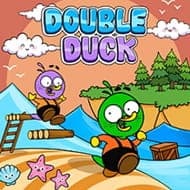
Double Duck looks like a cute Game Boy Color platformer about two small birds, and that impression lasts about four levels before the rotation mechanic starts demanding spatial thinking most platformers never ask for. Mars, the green duck, moves on the ground. Phobos, the purple duck, orbits Mars at a fixed distance and rotates clockwise on the B button — through walls, through floors, through anything — and every puzzle in the game is built around that single interaction. The two are always linked. Where Mars goes, the distance holds. What you do with Phobos determines whether you can actually get there.
| Genre | Puzzle-platformer |
| Platform | Game Boy Color (homebrew) |
| Levels | 11 |
| Collectibles | 3 hearts per level (optional 100%) |
The Rotation Mechanic in Double Duck
Phobos rotates in 45-degree increments around Mars. That single design choice turns every screen into a geometry problem. When Phobos points upward, he floats in the air above Mars, which you can use to reach ledges that would otherwise be too high for a ground jump. When Phobos points sideways and through a wall, you can use his position to drag Mars horizontally across gaps, because the fixed-distance tether pulls Mars wherever Phobos sits. The game calls this orbiting, and players quickly start talking about “the orbit” as shorthand for solving any given puzzle.
The obstacle set grows as you progress. Spikes punish sloppy positioning, springs launch Phobos in directions you need to predict before you press B, and certain platforms are solid for only one of the two ducks. That last type — one-duck platforms — is where Double Duck starts separating players who are experimenting from players who are genuinely reading the level. You cannot brute-force past a Mars-only platform with Phobos standing on it.
Once you reach the mid-game levels, the game adds rotation reversal. Some zones force Phobos to spin counter-clockwise, which inverts the muscle memory you have built over the first six or seven levels. Players who have been unconsciously relying on clockwise instincts find this jarring in exactly the way the game intends.
What New Players Miss About Mars and Phobos
The most overlooked tool in the game is Phobos-as-bridge. Most new players use Phobos as an extension of Mars — they rotate him to clear obstacles ahead. What takes longer to internalize is using Phobos’s fixed distance to measure gaps before committing a jump. If Phobos, when rotated to the horizontal position, does not reach the far ledge, Mars cannot reach it through a standard jump either. The ducks become a ruler, and that spatial reasoning is the skill the game is actually teaching.
Speedrunners in the homebrew community have discovered that wall-passing with Phobos can create shortcuts the level design appears to close off. Rotating Phobos through a solid wall and then walking Mars toward the tether can pull Mars past certain geometry faster than the intended path allows. The game’s 11 levels are short individually, and players chasing RetroAchievements completions tend to replay individual stages specifically to clean up the three heart collectibles that do not sit on the obvious route.
Difficulty and Honest Frustrations in Double Duck
Experienced puzzle-game players report finishing Double Duck in roughly an hour. Players less comfortable with spatial mechanics can take three or more hours, particularly in the back half of the level list. The game has checkpoints and unlimited retries, which removes the punishment from failure, but the short looping music track on repeat during extended attempts at a single puzzle is something the community consistently flags. When you are on your twelfth attempt at a layout with Phobos-only platforms and rotation reversal, the sound design does not help.
The difficulty curve is generally fair, but the jump from level 8 to level 9 feels steeper than the previous gaps. Players report reaching level 9 and needing to mentally reset their approach to Phobos positioning before the puzzle clicks. That wall is real, and it is not a sign you are doing something wrong — it is where the game shifts from teaching the mechanic to assuming you own it.
Casual puzzle fans may find the precision platforming elements frustrating. The ducks are small sprites on a Game Boy Color display, and timing a rotation while Mars is mid-jump requires the kind of input coordination that puzzle-only players are not always expecting from what looks like a casual game. That tension between cute presentation and actual mechanical demand is the most talked-about aspect of Double Duck in homebrew game communities.
Frequently Asked Questions About Double Duck
How does Phobos pass through walls in Double Duck?
Phobos orbits Mars at a fixed distance and his rotation path ignores solid terrain entirely. When you press B, Phobos moves clockwise through whatever is in the way — walls, floors, ceilings — while Mars stays grounded by standard gravity. This is a deliberate design choice rather than a glitch, and several levels are specifically built around routing Phobos through walls to access areas Mars cannot reach directly.
Do the heart collectibles in Double Duck affect the ending?
Collecting all three hearts in each level contributes to 100% completion and unlocks the RetroAchievements associated with each stage. The hearts are optional for finishing Double Duck but sit off the critical path, often requiring you to understand advanced Phobos positioning before you can reach them. They are designed as a secondary challenge for players who found the main route manageable.
Is Double Duck hard compared to other Game Boy Color puzzle games?
For a homebrew title, Double Duck sits in the mid-to-high difficulty range. The unique Mars-and-Phobos dual-character mechanic is genuinely novel, and the game does not have a traditional hint system. Players who enjoy spatial reasoning puzzles will find the challenge satisfying, while those who prefer pure logic puzzles without platforming precision may find certain later levels frustrating.
Double Duck is a small game that earns its reputation by committing fully to one idea and following it through 11 levels without padding or repetition. The moment Phobos starts phasing through a wall to pull Mars over an otherwise impossible gap is the moment the design reveals itself, and from there the game becomes a different kind of thinking exercise than it looked like from the title screen. Mars and Phobos are built around a single B-button interaction, and Double Duck never needs anything else.
Comments
There are no reviews yet. Be the first one to write one.