


-

Hide and Luig
-

Meccha Hunt
-

Fruit Ninja
-

Toaster Dash
-
Meccha Chameleon 3
-

Meccha Chameleon 2
-

Water Color Sort
-

Stickman Chameleon
-

Paint to Hide!
-

Paint&Seek Online
-
Meccha Obby
-

Paint or Seek: Chameleon Hide Online
-

Hide ‘N Seek!
-

Paint Strike
-

Meccha Chameleon Mobile
-

A Little to the Left
-

Among Us
-

Stickman Hook
Slope








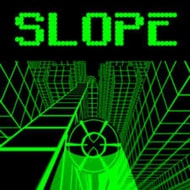
You nudge left a fraction too late, clip the edge of a red block, and the ball explodes off the track before your run even hits ten seconds. That is the rhythm of Slope: short, merciless, and over almost as fast as it started, which is exactly why players keep hitting restart instead of walking away.
| Genre | Endless 3D runner |
| Core Mechanic | Steering a rolling ball down an accelerating slope |
| Controls | Left and right steering keys |
| Objective | Survive as far down the track as possible |
| Failure Condition | Touching a red obstacle or falling off the track |
Momentum Control Inside Slope
The core mechanic is simple: a ball rolls automatically down a tilted, procedurally generated track, and your job is nudging it left or right to stay on the surface. Speed builds on its own as the track pitches steeper, and every second alive adds pressure to reactions that already felt tight a moment earlier. Early in a run the gaps are wide and forgiving; by the time speed has climbed for a minute or two, the same gaps demand commitment half a second earlier than instinct suggests.
Inertia is the part beginners underestimate most. The ball carries momentum through turns, so a hard tap in one direction keeps drifting after you let go, which is how runs end sliding into a wall players swear they steered away from. Cautious players who correct a full obstacle ahead of time survive longer than ones who wait until a red block is already under the ball.
Falling off the track kills a run just as fast as hitting an obstacle, and narrow bridges often carry both hazards at once.
Reading Track Patterns Before They Arrive
Slope’s track mixes a limited set of hazards fast enough that memorizing one sequence never works twice. Because the layout regenerates each attempt, players cannot brute-force a run by memorizing obstacle placement the way they might in a fixed-level platformer, a point that divides the community, since some find the randomness refreshing and others feel it robs a skilled run of consistency.
- Red slab obstacles that end the run instantly on contact
- Narrow bridge sections with no side barriers
- Sudden gaps that require committing to a straight line
- Tunnels that restrict steering room on both sides
Recognizing these shapes at a glance, rather than only once close, separates players who feel like they see the track coming from those still reacting blind. The ball visibly cracks apart on death, a small detail that still makes players wince on a hundredth restart.
Where New Players Lose Control
The single biggest mistake is aiming the ball at the center of the track and treating that as safe by default. Center positioning matters only as a starting reference – if you are not already leaning toward the side you will need next, that middle line becomes a trap the instant a gap or slab appears off to one side.
A repeatable routine helps more than raw reflexes once speed climbs past the point where reading obstacle by obstacle stops being possible.
- Keep the ball centered only as a resting position, not a goal
- Look two or three obstacle rows ahead instead of at the ball itself
- Commit to a steering direction early rather than correcting mid-obstacle
- Accept that late-run speed rewards positioning over reflexes
Most first-week players die from panic-steering into a wall while dodging a slab they had already cleared.
Score Chasing and Track Vocabulary
Slope has no levels, no checkpoints, and no story, and the game’s only progress marker is the number climbing in the corner, so players talk about runs like speedrun attempts even though nothing is timed. Community shorthand for a clean run with no near-misses is a “smooth run,” while a last-second dodge that barely clears a slab gets called a “clip” by regulars on forums and stream chat.
Score chasers nurse a promising run through close calls rather than reset on the first mistake.
Questions About Slope
Why does the ball keep sliding into obstacles I already avoided?
That drift comes from inertia, not misreading. The ball carries momentum through every turn, so letting go of the steering key does not stop its sideways motion immediately, and a slab you cleared can still catch a ball that has not finished sliding.
Does the track repeat if you play again?
No – the layout regenerates with each new run, so memorizing a sequence of slabs and gaps will not carry over to the next attempt, one of the more debated aspects of the game.
What actually ends a run in Slope?
Only two things end a run: touching a red slab or steering off the track’s edge into open space. Both are instant, with no second chance.
Slope keeps its scoring simple, but a genuinely high number means treating the center line as a resting point rather than a shield, and reading every red slab and gap far enough ahead to counter-steer before momentum makes the choice for you.
Comments
There are no reviews yet. Be the first one to write one.