


-

Hide and Luig
-

Meccha Hunt
-
Fruit Ninja
-
Toaster Dash
-
Meccha Chameleon 3
-

Meccha Chameleon 2
-

Water Color Sort
-

Stickman Chameleon
-
Paint to Hide!
-

Paint&Seek Online
-
Meccha Obby
-

Paint or Seek: Chameleon Hide Online
-

Hide ‘N Seek!
-

Paint Strike
-

Meccha Chameleon Mobile
-

A Little to the Left
-

Among Us
-

Stickman Hook
Cluster Rush






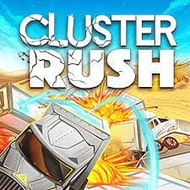
Thirty-five levels stand between you and the end of Cluster Rush, and not one of them gives you solid ground to stand on — every second of the game is spent leaping between moving, spinning, occasionally crashing trucks, with the road itself treated as instant failure if you ever actually touch it.
| Genre | First-Person Parkour |
| Levels | 35 |
| Core Mechanic | Jump between moving trucks without touching the ground |
| Movement | Double jump, wall jump, edge climbing |
Cluster Rush plays out entirely in first person, running and jumping across a convoy of trucks that are never fully still — they twist, spin, and sometimes crash into each other while you’re mid-leap between them. The core rule is simple: keep moving forward across the convoy, using timing and rhythm rather than pure speed to survive until the level’s finish line.
Why Landing on the Roof Isn’t the Only Option
A detail that separates Cluster Rush from a simpler platformer is that you don’t need to land cleanly on the center of a truck’s roof to survive — clinging and climbing to the sides of a carriage works too, which means a jump that looks like it’s about to fall short can still be salvaged by grabbing the edge and climbing up rather than dropping straight to the road below.
Treating every jump as a guaranteed roof-landing wastes the game’s most forgiving mechanic. Players who’ve cleared deep into the 35 levels describe deliberately aiming for a truck’s side rather than its center on tighter jumps, since the climb-up recovery is far more reliable than trying to stick a perfect landing at full speed.
Double Jumps and Wall Jumps Change the Timing Math
Neither the double jump nor the wall jump exists just for style — both extend how far a single leap can realistically cover, which matters constantly once trucks start spinning or drifting apart mid-jump. Reading when a gap is a double-jump distance versus a wall-jump distance, rather than defaulting to one or the other, is a skill that separates smooth runs from ones that stall out constantly on the same handful of trucks.
How Each Level’s Theme Changes the Danger
- Trucks weaving between fixed pillars, where positioning matters more than timing
- Trucks dodging spinning saw blades, where timing overrides positioning almost completely
- Trucks launched off ramps mid-convoy, adding sudden vertical movement to jumps that were already airborne
- Falling debris and swinging hazards layered on top of the moving trucks themselves
Because every level reuses the same core moveset but changes which hazard dominates, Cluster Rush avoids feeling repetitive across all 35 stages — a level built around saw blades demands a completely different rhythm than one built around ramps, even though the underlying jump-and-climb mechanics never change.
Escalating Difficulty Without New Mechanics
What makes the back half of Cluster Rush genuinely difficult isn’t new abilities being introduced — it’s the same double jump and wall jump you learned in level one, now demanded with far less room for error as trucks spin faster and gaps open and close on tighter windows. The physics stay dynamic and unpredictable throughout, which means memorizing a level’s layout only gets you partway; the actual truck movement still has to be read fresh on every attempt.
- What happens if you touch the ground in Cluster Rush? The attempt ends immediately — the ground is never a safe fallback, which is why climbing back onto a truck’s edge after a bad jump matters so much more than trying to force a clean landing.
- Is timing or positioning more important overall? It depends on the level’s dominant hazard — saw-blade-heavy stages lean on timing, while pillar-weaving stages lean on positioning, and reading which one a level demands early on saves a lot of repeated failed attempts.
Why First-Person Perspective Changes the Difficulty
Playing Cluster Rush from a first-person view rather than a third-person one removes a lot of the spatial information players might expect — you can’t see your own character’s full silhouette relative to the truck below, which makes distance judgment a skill you build through repetition rather than something the camera simply hands you. That limitation is part of what makes early attempts at a new level feel harder than the level’s actual layout might suggest; a chunk of the difficulty is really just learning to trust your depth perception in a perspective that doesn’t give you every visual cue a third-person camera would.
Once that trust is built, though, first-person view pays off in the opposite direction — it keeps your attention locked on exactly where you’re about to land, without a floating character model between your eyes and the truck’s edge to distract from the judgment call that actually matters.
Crashing Trucks as Both Hazard and Signal
A truck that’s about to crash into another one doesn’t just become a hazard — it also telegraphs the next few seconds of the convoy’s movement, since the collision itself changes how nearby trucks spin and drift afterward. Players who’ve spent real time in Cluster Rush’s later levels describe treating an incoming crash as information rather than pure danger, using the chaos it creates to judge where a safer landing spot is about to open up rather than only reacting to the collision itself.
By level 35, Cluster Rush has stopped being about any single jump and started being about trusting a climb-up recovery over a perfect landing — a shift in instinct that takes most players far longer to build than the actual jumping skill ever did.
Comments
There are no reviews yet. Be the first one to write one.