


-

Hide and Luig
-

Meccha Hunt
-

Fruit Ninja
-

Toaster Dash
-
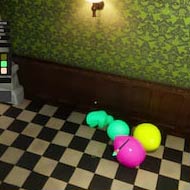
Meccha Chameleon 3
-

Meccha Chameleon 2
-

Water Color Sort
-

Stickman Chameleon
-

Paint to Hide!
-

Paint&Seek Online
-

Meccha Obby
-

Paint or Seek: Chameleon Hide Online
-

Hide ‘N Seek!
-

Paint Strike
-

Meccha Chameleon Mobile
-

A Little to the Left
-

Among Us
-

Stickman Hook
Speed Tier Transitions and Color Response Changes
You clear the final gate of Chromawoods Zone 3 and the screen transitions to Crystalfall Cavern’s opening and suddenly Meccha is moving at a speed that feels different — not drastically faster, but enough to make the first Crystalfall gate arrive sooner than the timing calibration from Chromawoods predicted. You switch for Chroma Yellow and the switch completes just before contact, which is noticeably less comfortable than the same switch would have felt two minutes earlier. This is the speed tier transition, and it happens three more times before you reach Chroma Void. Every transition requires recalibration, and the recalibration is not automatic.
How Speed Tiers Work in Meccha Chameleon
Meccha Chameleon uses five discrete speed tiers across its zone progression. Chromawoods operates at Tier 1. Crystalfall Cavern elevates to Tier 2. Neon District runs at Tier 3. Sunburst Plains pushes Tier 4. Chroma Void and beyond operate at Tier 5. Each tier increase is approximately 15% faster than the previous, which sounds modest but compounds across the three-to-four-tier progression most players experience in a complete run. By Chroma Void, Meccha is moving roughly 60% faster than in Chromawoods.
The tier increase is not gradual within a zone — it is a discrete step at each zone transition. This means the player experiences the new speed immediately upon entering the zone rather than having it introduced through gradually increasing gate density. Some players find this jarring; others prefer knowing exactly where the speed change is rather than being uncertain when it will arrive. The community consensus is that discrete tier steps are preferable to gradual increases because they create predictable recalibration moments rather than a continuous demand to assess current speed.
Zone-internal speed increases do occur within some zones: specific Neon District corridors run at slightly above Tier 3 speed as part of their design, and the late-stage Chroma Void sections push past standard Tier 5 toward what the community calls Tier 5.5 for distinguishing purposes. These intra-zone speed bumps are less pronounced than zone transition steps but are responsible for a category of unexpected misses in the community — players who have calibrated for zone-standard Tier 3 and suddenly encounter a Tier 3.5 corridor in late Neon District without recognizing that the speed has changed.
What Changes When Speed Increases
At a higher speed tier, four things change in Meccha Chameleon: gate approach time (less time between becoming visible and reaching contact), effective switch window (the period during which a switch can be initiated and still complete before contact), Mirror Lizard reaction time (less time to process and apply the reflection mapping), and ChromaChain recovery time (after a miss stun, less time before the next gate arrives during the stun recovery).
The switch window reduction is the most impactful change for players actively working on their ChromaChain. A switch window that was comfortable at Tier 1 becomes adequate at Tier 2, tight at Tier 3, and requires precise timing at Tier 4. Players who have internalized the switch timing as a felt sense — the timing that “feels right” — need to recalibrate that felt sense at each new tier rather than applying the same timing that worked before. The recalibration is not just moving faster; it is finding a new felt-rhythm that matches the new gate approach speed.
ChromaChain recovery time changes are particularly punishing in Chroma Void. At Tier 5, a miss stun that lasts 0.5 seconds can have the next gate arriving at 0.4 seconds into the stun — before the stun clears. The player physically cannot switch out of the stun quickly enough to prevent a cascade miss. This means that at Tier 5, a single initial miss has a significantly higher probability of triggering two or three consecutive losses than the same initial miss would at Tier 1. Managing the pre-Tier-5 Life Gem count — arriving at Chroma Void with all three gems intact — is the preparation strategy that most effectively reduces Tier 5 cascade damage.
How to Recalibrate After a Tier Transition
The fastest recalibration approach after a tier transition is the first-three-gates test: focus exclusively on the timing of the first three gates in the new zone and assess whether the switch completes before contact or at-contact. A switch that completes comfortably before contact means existing timing has transferred adequately. A switch that completes at-contact or slightly after indicates the timing needs to be moved approximately one gate-length earlier in the new tier. Three gates is enough to sense whether the old timing is sufficient or requires adjustment.
Intentional recalibration practice — deliberately playing only the opening of a new zone to isolate the tier transition rather than attempting full runs — is the method recommended by the Meccha Chameleon community for players who have plateaued at a specific zone-entry failure point. Players who consistently survive Neon District but fail in Chroma Void’s first corridor benefit from running only Chroma Void’s opening repeatedly until Tier 5 timing is internalized, rather than running the full game each time and encountering Tier 5 only once per long session. Isolated tier practice produces faster recalibration than incidental encounter.
Speed tier transitions in Meccha Chameleon are not the game becoming unfair — they are the game asking whether the skill level that carried the player through the previous zone extends to the new speed. Most players who fail at a zone transition are not failing because the zone is specifically difficult; they are failing because the recalibration step was not completed before pressing forward. The tier transition is both the challenge and the announcement that the challenge exists, and responding to the announcement is the whole skill.