


-

Hide and Luig
-

Meccha Hunt
-

Fruit Ninja
-
Toaster Dash
-
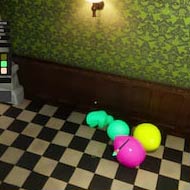
Meccha Chameleon 3
-

Meccha Chameleon 2
-

Water Color Sort
-
Stickman Chameleon
-

Paint to Hide!
-

Paint&Seek Online
-

Meccha Obby
-

Paint or Seek: Chameleon Hide Online
-

Hide ‘N Seek!
-

Paint Strike
-

Meccha Chameleon Mobile
-

A Little to the Left
-

Among Us
-

Stickman Hook
Why Level Three Breaks Most Beginners
Meccha Chameleon’s third level looks like a routine color-gate run and plays like an early filter. Most players get through levels one and two without a miss, assume the game is exactly as straightforward as the first two levels suggest, and then encounter level three’s gate-cluster section and lose two Life Gems in four seconds. The level three cluster is not difficult by the standards of Crystalfall Cavern or beyond. But it does three things simultaneously that levels one and two never do, and the combination breaks the assumption most beginners carry into Meccha Chameleon from the first two stages.
What Level Three Actually Does That Levels One and Two Do Not
Level one uses two colors and generous gate spacing. Level two adds one harder sequence of two consecutive same-colored gates that require the player to hold a color across two contacts rather than switching between each. Both levels are designed as mechanics demonstrations, not difficulty tests. Level three’s opening section maintains the same feel — two colors, spaced gates, comfortable rhythm — and then, at approximately the 40% mark of the level, introduces the cluster: five gates in rapid succession where the color pattern is not sequential but mixed, requiring three switches within the cluster window.
The cluster’s color pattern on standard level three is: Red, Blue, Red, Blue, Red. This looks simple, but the critical feature is the gate spacing within the cluster, which is approximately 40% tighter than the spacing in levels one and two. Players who have calibrated their switch timing to the generous level one and two spacing arrive at the second gate in the cluster still mid-switch from the first. The switch animation is running, the color has not yet fully registered, and the second gate arrives before the switch completes. The result is a miss on a gate the player technically switched for.
This is the first encounter most Meccha Chameleon players have with the distinction between initiating a color switch and completing one. Levels one and two are spaced so that any switch initiated well before the gate completes before contact — the spacing is forgiving enough that timing precision is irrelevant. Level three’s cluster is not. The cluster is where the game communicates that color switches need to begin earlier than the gate’s visual position suggests.
How to Approach the Level Three Cluster
The correct preparation for the level three cluster is switching to the first cluster color before entering the cluster. The Red-Blue-Red-Blue-Red pattern begins with Red; arriving at the first cluster gate already wearing Chroma Red means the first gate contact is clean and the player begins switching to Blue immediately after contact rather than starting the switch from the wrong color at the gate’s threshold.
Players who spend more than three attempts on the level three cluster without changing their approach are typically doing one of two things: switching at the gate frame (too late for the cluster spacing) or failing to start the first switch before the cluster entry. The fastest diagnostic is to observe at which gate in the sequence the first miss occurs. A first-gate miss indicates the player arrived in the wrong color for the cluster’s opening. A second-gate miss indicates the switch from the first gate to the second was initiated too late. A fourth-gate miss indicates the player ran out of switch speed in the pattern’s longer middle stretch.
Once the cluster approach is fixed — arrive in Chroma Red before the cluster, switch to Blue immediately after the first gate, switch back to Red immediately after the second, and continue — the cluster becomes manageable on consistent practice. Most players report that the level three cluster takes three to eight intentional attempts after understanding what it is testing before it becomes reliable. Players who reach that reliability point discover that the same preparation-before-cluster habit transfers directly to every subsequent challenging gate sequence in the game.
Why Level Three Breaks More Players Than Level Seven
Counterintuitively, level three generates more first-time run failures than level seven despite level seven being objectively harder by gate density and color variety. The reason is expectation calibration. Level seven players have already failed repeatedly on earlier content and have adjusted their mental model of the game’s difficulty. Level three players are still operating on the assumption that the game is as easy as levels one and two established — the expectation mismatch amplifies the experience of failure beyond what the actual difficulty warrants.
This pattern is well-documented in the Meccha Chameleon community. Players who post asking for help with the game almost always post after encountering the level three cluster rather than after later zones. The post content is typically some form of surprise — the game suddenly became difficult without warning. Experienced players in these discussions consistently identify the level three cluster as the game’s first legitimate difficulty requirement rather than a tutorial element, which is the information the struggling players need most.
- Is the level three cluster always the same pattern? Yes. Level three’s gate cluster uses the same Red-Blue-Red-Blue-Red pattern on every run. The pattern is not procedurally generated — it is a fixed design decision that serves as the game’s first structured difficulty test. This means the cluster is learnable through repetition rather than requiring adaptation to variety. Players who intentionally practice the cluster in isolation by replaying level three report that the pattern becomes automatic within five to ten dedicated attempts, at which point the challenge has fully transferred to preparation timing rather than color memory.
- Do later levels repeat the cluster format? Yes, with increased complexity. The cluster format — multiple rapid gates requiring alternating color switches within tight spacing — recurs throughout Meccha Chameleon’s zone progression with two modifications: the pattern becomes longer (seven or nine gates rather than five) and the pattern becomes less predictable (color repetitions become less regular, requiring full pattern reading rather than alternating-color assumption). Level three’s specific alternating Red-Blue-Red structure teaches the timing skill; later clusters test whether that timing can be applied without the predictable pattern.
- What if I keep losing Life Gems in the cluster and running out by the end? Losing Life Gems in level three’s cluster and then dying to later level content is the most common progression-block in the game’s early stages. The solution is specific: practice the cluster until it costs zero Life Gems before treating level completion as the goal. A cluster that regularly costs one or two gems means the switch timing has not been internalized yet, and attempting to survive the rest of the level while gem-deficient builds a habit of playing in gem-recovery mode rather than color-reading mode. Get the cluster clean first; the rest of the level rewards the same preparation habit.
Level three’s cluster is not a difficulty spike that appears without justification — it is the game’s first honest test of whether the habits learned in levels one and two have been correctly calibrated. Players who approach it as a skill check rather than an obstacle discover that the cluster is actually a gift: it identifies exactly which aspect of color-switching timing is underdeveloped before the game sends the player into Crystalfall Cavern, where underdeveloped timing is a much more significant problem. The level three cluster is Meccha Chameleon telling you something important early enough to act on it.